Artificial Intelligence (AI) is changing the world. To become an AI specialist, you need to learn step by step. Absolutely, AI is shaping the future. From self-driving cars to smart assistants like Siri and Alexa, artificial intelligence is everywhere. But have you ever wondered, “How can I become an AI specialist?”
If you are a student, a working professional, or just curious, do not worry. You do not need to be a genius. You just need a clear path. This article will show you exactly how to become an AI specialist with real examples and a step-by-step guide.
An AI specialist is a professional who develops new solutions using AI applications and other software. These specialists work in different areas such as machine learning, data science, robotics, computer vision, and natural language processing.
Modern technology is advancing rapidly, and the demand for AI specialists is growing. Big tech companies hire skilled AI professionals who can build smart things and solve complex problems.
Many tech lovers and students want to become an AI specialist or want to start a career in artificial intelligence. If you aim to become an AI expert, this guide is helpful for you, and you can learn all about AI in this article. I will explain everything in detail it is more beneficial for you. The question is, what will you learn in this guide? You should read the following.
What is Artificial Intelligence
Artificial intelligence is a branch of technology or computer science that creates machines and automates systems that can perform tasks that normally require human intelligence. Such as learning, reasoning, problem-solving, understanding languages, and making decisions fast compared to humans.
In simple words, artificial intelligence (AI) is the technology operate computers and machines to think fast, learn from data, and act intelligently without being directly programmed for every action.
Here are some simple examples of artificial intelligence (AI) in everyday life:
We use artificial intelligence (AI) every day in many things. For example, voice assistants like Google Assistant, Siri, and Alexa listen and answer us quickly. Many businesses and platforms get help from AI, for example, YouTube, Netflix, Meta, and TikTok use AI to show videos or content we like.
Also, many shopping platforms like Amazon, Walmart, eBay, Alibaba, Daraz, etc., use AI to suggest products we may want. Social media platforms also use AI to show posts, ads, and content based on our interests. In simple words, AI helps machine learning understand and perform like humans.
What Is an AI Specialist?
An AI specialist is a professional who develops, designs, implements, or manages artificial intelligence solutions to solve complex problems in business, or even if these problems are technical. AI experts use different modules, such as machine learning, deep learning, and natural language processing. Artificial intelligence experts are very smart people who train machines to solve complex problems and perform advanced tasks quickly.
Key Responsibilities of an AI Expert
- Building AI models for tasks like prediction, classification, recommendation, or automation.
- Developing machine learning systems using tools such as Python, TensorFlow, PyTorch, or scikit-learn.
- Working with generative AI (e.g., large language models, chatbots, AI assistants).
- Preparing and analyzing data to train AI systems.
- Integrating AI into business processes to improve efficiency and decision-making.
- Monitoring and improving AI performance after deployment.
- Ensuring responsible AI use, including privacy, fairness, and compliance.
AI specialists are helping many industries to automate work and complete daily tasks fast. These industries include healthcare, finance, manufacturing, education, transportation, cybersecurity, and e-commerce. AI is growing day by day, and an AI specialist is becoming a high-paying person in the future.
Why Become an AI Specialist: Top 6 Reasons
Many people search daily, “Why become an AI specialist?” The answer is simple: because they want a safe, high-paying, future-proof job. Here are some top reasons why you should have a career in the artificial intelligence field.
High Demand for AI Professionals
Big tech companies and businesses are investing heavily in AI technology. Companies need experts who can operate and build artficial intelligent systems and automate work processes.
Excellent Salary Opportunities
AI specialists often earn higher salaries than many other technology professionals because their skills are highly valuable right now and in the future. They earn approximately $ 100000 to $ 150000 per year.
Global Career Opportunities
AI jobs are available worldwide every day; tech industries launch new AI tools and applications. You can work remotely or for international companies.
Continuous Learning
The AI field evolves quickly day by day, making it exciting for people who enjoy learning new technologies. If you are planning to learn AI, you need to stay in touch with AI news and updates.
Opportunity to Solve Real Problems
AI helps solve challenges in less time and with accurate results. Such as, AI helps in handling social media campaigns, customer service, healthcare, education, business, agriculture, and many other industries.
How to Become an AI Specialist from Scratch
Many beginners ask, “Can I become an AI specialist without experience?” The answer is yes. You can start from the beginning and gradually build your skills.
1: Let’s Start Learning from Basic Computer Skills: Your Foundation
Before studying artificial intelligence, you need to understand basic computers and technology. You must understand how computers work before you even write a single line of AI code.
A. Learn Operating Systems – The Computer’s Brain
An operating system (OS) is the brain of a computer, the main software that runs your computer. Its manage everything in a computer, like files, programs, the internet, and hardware. As an AI specialist, you will most likely use it.
- Windows (most common, user-friendly)
- macOS (used by Apple, very smooth)
- Linux (especially Ubuntu) – This is very important and useful for AI. Mostly, AI servers and cloud computers operate on Linux. You need to know everything to become an AI expert. The following are basic things you should know.
- How to open the terminal (command line)
- How to create, copy, move, and delete files using commands
- How to install software using
sudo apt-get install
Action step: If you have a Windows computer, install VirtualBox and try Ubuntu for free. Practice 10 basic Linux commands daily.
B. Computer Hardware – The Physical Parts
To perform or build an AI application, you don’t need to be a hardware engineer. Definitely, AI is heavy work for a computer. But you must know the following hardware parts.
- CPU (Central Processing Unit) CPU is called central processing unit The brain of the computer. Does general calculations.
- RAM (Random Access Memory) Short-term memory. More RAM means you can handle bigger data.
- GPU (Graphics Processing Unit) Originally made for games, now used for AI. GPUs are super fast at doing many small calculations together. This is why AI specialists love NVIDIA GPUs.
- Storage (SSD/HDD) – Where you save your data and AI models. SSD is faster to HHD. SSD is recommended by computer engineers and IT experts. If you want to speed up your work, you should use SSD.
Simple analogy: CPU = a smart professor (solves complex problems slowly). GPU = 1,000 school kids (solve simple problems super fast together).
Minimum requirements to start learning AI:
- 8 GB RAM (16 GB is better because it processes data fast and is also best for time saving)
- Any processor (i5 or i7 recommended, but if you can afford the higher version of the processor, it helps you operate heavy software fast.
- No GPU needed initially (Google Colab gives you a free GPU in the cloud)
C. Software Applications
You will use many software tools daily to complete different tasks. These are essential software tools for AI development you should need before starting as an AI expert.
| Software | Purpose | Free? |
|---|---|---|
| Google Chrome / Firefox | Browse the internet, open Google Colab | Yes |
| VS Code | Write and edit code (very popular) | Yes |
| Jupyter Notebook | Write Python code in small blocks | Yes |
| Git | Save different versions of your code | Yes |
| Anaconda | Manages Python packages easily | Yes |
| Zoom / Google Meet | Attend meetings and interviews | Yes |
How to practice: Become an AI Specialist
Example: Download VS Code today. Open it. Write a simple HTML page or a text file. Get comfortable with menus, shortcuts (Ctrl+S to save, Ctrl+C to copy), and settings.
D. Internet Technologies – How Computers Talk
Artificial intelligence often works on the internet or online. You need to know basic internet concepts before getting started.
- What is the internet? A network of millions of computers connected.
- What is a browser? Software (like Google Chrome, Microsoft Bing, Yahoo, Baidu, Yandex, etc.) to browse data and websites.
- What is a server? A powerful computer that stores websites and data.
- What is a cloud? Someone else’s computer that you rent (like Google Cloud, AWS).
- APIs (Application Programming Interfaces) – These allow two software programs to talk. For example, your AI sends a photo to Google’s Vision API, and Google sends back “This is a cat.”
Action step: Type “what is my IP address” in Google. See how your computer is identified on the internet. Explore how a website loads.
2: Learn Basic Programming Concepts to Become an AI Specialist– Before Python
You should understand general programming ideas before learning Python. Python is an important programming language for being a professional in artificial intelligence. AI experts work
Concept 1: Variables – Boxes That Store Information
A variable is a box with a label on it. You put something in it, and you give it a name so you can find it when you need it.
Real Life Example: Suppose you have a lunch box. You put your name on it. You put a sandwich inside. Then when you get hungry, you open up the lunchbox and eat the sandwich.
In programming:
text
age = 10
name = "Riya"
price = 99.99
is_student = True
Explanation:
ageis a box that stores the number 10.nameis a box that stores the text “Riya”.priceis a box that stores the decimal 99.99.is_studentis a box that stores the value True (yes, she is a student).
Why this matters for AI:
AI uses thousands of variables. Example: accuracy = 0.95 (The AI is 95% correct.) prediction = "cat" (the AI thinks it sees a cat).
Remember: A variable always has a name, e.g. age, and a value, e.g. 10. You can change the value at any time, you can substitute a sandwich for an apple.
Concept 2: Data Types – AI Specialists Use Different Kinds of Information
Not all information is of equal worth. You have numbers and words and true-false answers. These are known as data types. They are in all programming languages.
| Data Type | What It Stores | Example | When to Use |
|---|---|---|---|
| Integer (int) | Whole numbers (no decimals) | 5, 100, -3 | Counting people, age, number of cats |
| Float (decimal) | Numbers with decimals | 5.5, 3.14, -0.99 | Price, temperature, accuracy percentage |
| String (str) | Text (words, sentences) | "Hello", "I love AI", "Cat" | Names, messages, labels |
| Boolean (bool) | True or False | True, False | Yes/No answers, is it raining? |
Real-life example:
- Your age is an integer (10).
- Your height is a float (4.5 feet).
- Your name is a string (“Riya”).
- Are you a student? That’s a boolean (True).
In programming:
text
age = 10              # integer
height = 4.5          # float
name = "Riya"         # string
is_student = True     # boolean
Why this matters for AI:
AI works with all these types:
- Integers: Counting how many cats in a picture.
- Floats: Probability that it will rain (0.75 = 75%).
- Strings: The label “cat” or “dog”.
- Booleans: Is this image a cat? True or false.
Remember: You will crash your program if you mix data types. For example, you cannot add a number and a word ( 5 + ” apple ” = error ) . So what data are you using? You need to know.
Concept 3: Input and Output – Getting Data and Showing Results
Computers are useless if they cannot take input and show output. This is how they talk to us.
Input – Getting data from the user (you).
Output – Showing results to the user.
Real-life example:
- Input: You tell a waiter, “I want pizza.”
- Processing: The waiter tells the chef.
- Output: The chef gives you pizza.
In programming:
text
name = input("What is your name? ")    # Input
print("Hello " + name)                  # Output
If you type “Riya”, the computer will show the following: Hello Riya
Why this matters for AI:
- Input: User uploads a photo (input data).
- Processing: AI analyzes the photo.
- Output: AI says “This is a cat” (output prediction).
Remember: Input is what goes IN. Output is what comes OUT. AI is all about taking input, processing it, and giving meaningful output.
Concept 4: Conditions – Making Decisions
A computer can make decisions during data processing. It can check whether something is true or false, according to provided data, or it can perform different actions. This is called a condition or if else statment.
Real-life example:
- If it is raining → take an umbrella.
- Else (if not raining) → wear sunglasses.
In programming:
text
weather = "rainy"
if weather == "rainy":
    print("Take an umbrella")
else:
    print("Wear sunglasses")
Why this matters for AI:
AI uses conditions everywhere:
- If the AI is 90% sure it’s a cat → say “cat”.
- Else if it’s 80% sure it’s a dog → say “dog”.
- Else → say “I don’t know”.
Remember: This is an important note to become an AI specialist. Conditions help computers choose between different paths. AI uses hundreds of conditions to make decisions.
Concept 5: Loops – AI Specialist Required Actions
Sometimes you need to repeat an action many times. Like, if you want to write the same code 100 times, thats look waste of time and is boring. Instead, you use a loop.
Real-life example:
If you want to say “I love AI” 10 times, you don’t write it 10 times. You say: “Repeat 10 times: I love AI.”
In programming (for loop):
for i in range(10):
    print("I love AI")
This will print:
I love AI
I love AI
I love AI
... (10 times)
Why this matters for AI:
AI uses loops constantly:
- Go through 10,000 photos one by one.
- Check each photo and decide: cat or dog?
- Repeat until all photos are checked.
Remember: Using loops saves your time. Instead of writing the same code many times, which takes time, you write it once and tell the computer to repeat it.
3: How to Learn Mathematics for AI and Machine Learning
Sometimes you need to repeat an action many times. Like, if you want to write the same code 100 times, thats look waste of time and is boring. Instead, that looks like a loop. Most people stop learning because of hard math. But math is not difficult for an AI specialist, you only need to cover three simple topics.
1: Linear Algebra for Artificial Intelligence
Artificial Intelligence uses linear algebra, which is very important for an AI expert. It is also important to understand machine learning and data science. Also, it helps computers to process big data, recognize patterns, and understand images. Mostly, AI algorithms depend on linear algebra to perform calculations fast and accurately.
Some of the main topics in linear algebra include:
- Matrices: AI systems use matrices to process and store large datasets. Arrays of numbers arranged in rows and columns.
- Vectors: Mathematical objects that indicate data points and values. Vectors are used in machine learning and computer vision.
- Transformations: The mathematical process that changes the positions, shape, or size of data. Transformations help artificial intelligence models analyse images, complex datasets, and graphics.
AI specialist should have a strong understanding of linear algebra to build better machine learning models and work more effectively.
2. Statistics and Probability for Artificial Intelligence Specialist
AI models use statistical methods. Statistics and probability are very important areas of mathematics in AI and machine learning. AI systems easily understand data, identify patterns, and make decisions with the help of statistics and probability.
- Mean: Artificial intelligence systems use the mean to understand the exact value of data. The average value of a set of numbers.
- Median: Median is the most important tool in statistics and AI for handling skewed data, such as data with valid outliers. The median helps to analyze data without being affected by outliers.
- Probability: Let me break down exactly how probability works in AI. Probability also helps artificial intelligence models to make predictions and estimate outcomes based on available data.
The likelihood of an event happening, expressed as a number between 0 (impossible) and 1 (certain). Formula: P(Event) = (Favorable Outcomes) ÷ (Total Possible Outcomes). Example: Flipping a fair coin → P(Heads) = 1 ÷ 2 = 0.5 (or 50%) - Data Analysis: Data analysis is the backbone between raw numbers, robust summaries, and uncertain predictions. You need high-quality data analysis. The core skill for building effective AI and machine learning systems is high-quality data analysis
3: Calculus Importance For AI Specialist
Calculus is the engine that actually makes AI learn. If you want to start a career in AI, you need to understand deeply all about what is calculus in AI. Calculus is what AI uses to improve itself over time by finding the best internal settings to reduce or correct mistakes. There are two main calculus models used in AI, differential calculus and integral calculus.
Some of the key topics in calculus include:
- Derivatives: How values change over time during the process. Derivatives in AI help to measure values. As well as it help to determine how changes in data affect the performance of machine learning models.
- Gradients: Gradients indicate the direction and any changes in a function. Machine learning algorithms use gradients to adjust AI model parameters and see if anything is working incorrectly. Follow the example below.
text
Gradient = +3  →  Error is going UP fast  →  Turn the dial DOWN by a big step
Gradient = -1  →  Error is going DOWN slow →  Turn the dial UP by a small step
Gradient = 0   →  Error isn't moving       →  Leave the dial ALONE (you nailed it!)
- Optimization: Optimization is the method of looking for the best possible solution to resolve a problem. AI models use a data optimization process to reduce errors and achieve better results.
4: Understand Data Science Fundamentals to Become an AI Engineer
AI systems depend on data. Data is often called the fuel of artificial intelligence. It helps with learning, making decisions, and improving over time. AI models cannot perform well without high-quality data. That is why every AI expert needs to understand the fundamentals of data science.
Some of The Key Data Science Skills Include For Best AI career opportunities:
- Data Cleaning: Data cleaning is one of the most important parts; clean data helps improve the accuracy of AI models. The process of removing errors, missing information, and duplicate data is called data cleaning.
- Data Visualization: Presenting data through charts, graphs, and dashboards is called data visualization. The visualization process makes it easier to understand trends and patterns in data.
- Data Analysis: Analysis or examination of data to discover patterns and meaningful insights that can help in decision-making.
- Data Processing: An important step in AI and machine learning. Organizing and transforming raw data into a helpful format. It can be used by machine learning and AI systems.
- Feature Engineering: Selection, creation, and optimization of data features leading to better and more accurate predictions for machine learning algorithms.
- Data Collection: Collecting data from various sources, including websites, databases, sensors, and business records. For building reliable AI systems, collecting high-quality data is critical.
- Data Management: Safe storage, management, and maintenance of data for easy access and use when needed.
- Big Data Handling: Processing large amounts of structured and unstructured data. Many AI applications depend on large data sets to recognize patterns and make accurate predictions.
Data science knowledge is a critical skill for AI experts to manage big data, develop robust machine learning models, and design intelligent applications that deliver accurate and meaningful results.
5: How to Learn Machine Learning Essential Skills for an AI Career
One of the most important branches of artificial intelligence is machine learning. It allows computers to learn from data, detect patterns, and make decisions without being programmed for every task.
If you want to be an AI specialist, you need to learn machine learning. It is the foundation of many AI applications used in business, healthcare, finance, education, and technology.
What Is Machine Learning?
Machine learning (ML) is a technology or subset of artificial intelligence (AI) that allows computers to learn from data and improve their performance over time. Instead of following fixed instructions, machine learning algorithms identify patterns, analyze data, and make predictions or decisions.
Machine learning (ML) handles many of the artificial intelligence systems we use every day, including:
- Product recommendation systems
- Email spam detection
- Fraud detection in banking
- Voice assistants
- Search engines
- Personalized content suggestions
Types of Machine Learning
There are three major types of machine learning that every AI specialist needs to know. Machine learning (ML) is an important part of becoming an AI engineer. Three main types of machine learning are supervised learning, unsupervised learning, and reinforcement learning.
1: What is Supervised Learning
If you want to train machine learning models, you need labeled data to use supervised learning. A supervised learning system learns from examples where the correct answers are already known. Then the supervised system uses the knowledge to make predictions on new data. in simple words, supervised learning uses organized or labeled data to train machine learning models.
Examples of Supervised Learning:
- Email classification
- House price prediction
- Medical diagnosis
- Customer churn prediction
2: What is Unsupervised Learning
An unsupervised learning system works with unorganised or unlabeled data. An unsupervised learning system analyzes data and discovers hidden patterns, relationships, and groupings without predefined answers. You need to understand the examples given below.
Examples of Unsupervised Learning:
- Customer segmentation
- Data clustering
- Market basket analysis
- Pattern recognition
EX1: For example, a company may have thousands of customers with different buying habits, ages, and interests. Now, an unsupervised learning artificial intelligence system organizes data into different categories and groups similar customers. This helps businesses create targeted marketing campaigns without providing supervised or labeled data beforehand.
What is Reinforcement Learning
Reinforcement learning is an interesting part of machine learning. Reinforcement learning guides machines by giving rewards and penalties. The system learns by interacting with its environment. Based on feedback, it improves its decisions.
Examples of Reinforcement Learning:
- Robotics
- Self-driving vehicles
- Game-playing AI
- Automated decision-making systems
Understanding these three major machine learning models provides a strong foundation for building an intelligent AI system. Every technology expert needs to know this if they want to start a career in machine learning and become an AI specialist. They must have strong knowledge of machine learning to step ahead in the world of artificial intelligence. Continue learning. You can explore advanced topics such as deep learning, neural networks, natural language processing (NLP), and computer vision for the best AI career opportunities.
6: Learn Deep Learning to Become an Advanced AI Developer
Deep learning is a subfield of machine learning that mainly focuses on training AI neural networks to learn from large amounts of data. Deep learning has advanced AI development systems. These neural networks work like the human brain and are inspired by its structure and function. This allows computers to recognize patterns automatically, make decisions, and solve complex problems.
If we say deep learning is one of the most powerful technologies in modern artificial intelligence? The answer is yes. Also, it’s responsible for many of the artificial intelligence applications that we use every day. If you want to become an extraordinary AI engineer and one of the best, you must have deep knowledge of deep learning.
What is deep learning?
Deep learning is a subset of machine learning that uses multiple layers of artificial neural networks to automatically learn from data and process information. The more data it gets, the better it becomes at recognizing patterns and making accurate predictions.
Deep learning is applied in many industries such as health care, finance, transportation, education, technology, etc.
Applications of Deep Learning
Deep learning powers many advanced AI systems, including:
- Self-driving cars
- Image and facial recognition
- Speech recognition systems
- AI chatbots and virtual assistants
- Language translation tools
- Medical image analysis
- Recommendation systems
Popular Deep Learning Frameworks
Deep learning models are built and trained by AI specialists using powerful libraries and frameworks. Some of the most popular deep learning frameworks are.
- TensorFlow: An open-source framework developed by Google for building machine learning and deep learning applications.
- PyTorch: A widely used deep learning framework known for its flexibility, simplicity, and strong support from the AI research community.
- Keras: A beginner-friendly deep learning library that simplifies the process of creating and training neural networks.
Why Learn Deep Learning?
In the AI field, deep learning skills are very valuable. If you learn about deep learning frameworks and neural network concepts. You can make more advanced AI applications. A strong grip on deep learning opens more opportunities in the artificial intelligence industry.
Learning how to do deep learning well is a key part of becoming a successful AI expert and working on the next wave of smart technology.
7: NLP for AI Specialist: How to Learn Natural Language Processing (NLP)
Natural Language Processing (NLP) is a subdivision of artificial intelligence that enables computers to analyze, interpret, and react to human language. It blends machine learning, linguistics, and data science to enable natural communication between robots and humans.
NLP is one of the major fields in artificial intelligence. NLP (natural language processing) helps computers understand and respond to human language. It blends machine learning, linguistics, and data science to enable natural communication between robots and humans. NLP is one of the most important branches in AI. The reason is that it allows computers to process text and speech just like humans. If you want to start a career in artificial intelligence, NLP can open many doors in AI development.
What Is Natural Language Processing in Artificial Intelligence?
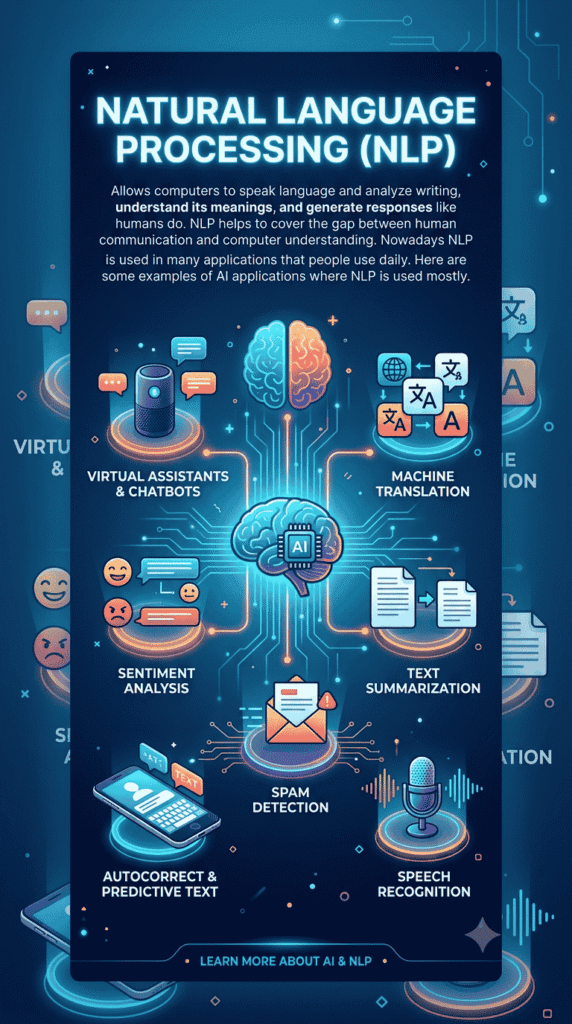
NLP (Natural Language Processing) allows computers to speak language and analyze writing, understand its meanings, and generate responses as humans do. NLP helps to cover the gap between human communication and computer understanding. Nowadays, NLP is used in many applications that people use daily. Here are some examples of AI applications where NLP is used most.
Applications of Natural Language Processing
- AI chatbots
- Language translation tools
- Voice assistants
- Search engines
- AI writing assistants
- Virtual customer support systems
- Speech-to-text software
- Text summarization tools
Important NLP Concepts
Understanding natural language processing (NLP). You need to know the following concepts.
- Text Processing: Cleaning and preparing text data so AI models can understand and analyze it effectively.
- Sentiment Analysis: Determining whether a piece of text expresses positive, negative, or neutral emotions.
- Language Modeling: Teaching AI systems to predict words, understand context, and generate meaningful text.
- Text Classification: Automatically organizing text into categories, such as spam detection, topic classification, or customer feedback analysis.
Why Learn NLP?
One area of artificial intelligence that is growing the fastest is natural language processing. Natural Language Processing (NLP) helps companies provide better customer service, automate communication, read and understand large amounts of text, and make smart apps.
Learning NLP can help you make more advanced AI systems, smart language-based apps, and more job possibilities in the field of AI. NLP skills will still be very useful for future AI experts even as AI keeps getting better.
8: Learn Computer Vision Skills to Become an AI Expert
Computer vision is a field of artificial intelligence that helps computers understand, evaluate, and make sense of pictures and video clips. Computers can use this information to find things, identify faces, find patterns, and make selections based on what they see.
The field of computer vision is one of the most interesting and quickly growing fields in AI. It’s used in many sectors like healthcare, transportation, security, manufacturing, and retail.
What Is Computer Vision?
Computer vision is the study of how machines see and understand the visual world. When computer vision systems use machine learning and deep learning, they can process videos and images and figure out what they mean.
These systems are very good at identifying things, following people’s movements, and looking at visual data.
Applications of Computer Vision
Computer vision powers many modern technologies and AI applications, including
- Face recognition systems
- Medical imaging and diagnosis
- Security and surveillance systems
- Self-driving vehicles
- Image search engines
- Augmented reality applications
- Industrial quality inspection
- Smart retail solutions
Important Computer Vision Tools
To work in computer vision, AI specialists commonly use the following tools and frameworks:
- OpenCV: An open-source computer vision library used for image processing, object detection, and video analysis.
- TensorFlow: A powerful machine learning framework that helps developers build and train computer vision models.
- PyTorch: A popular deep learning framework widely used for computer vision research and application development.
Why Learn Computer Vision? To Become an AI Specialist
Computer vision is transforming how machines interact with the world. Big tech industries use computer vision to automate tasks, improve security, enhance healthcare services, and create smarter products.
Learning computer vision can help you build advanced AI applications, work on innovative technologies, and increase your career opportunities in artificial intelligence. As AI adoption continues to grow, computer vision skills will remain highly valuable across many industries.
9: Best Educational Path to Become an AI Specialist
Many artificial intelligence professionals have formal basic education in tech-related fields. A university degree is not always required to become an AI specialist. Nowadays, you can learn through online courses. I know some AI experts who learn online and don’t have traditional educational degrees, and they are successful. The most important factor is developing the right skills and gaining hands-on experience with artificial intelligence technologies.
Degree Options for AI Careers
A degree can provide a strong foundation in artificial intelligence, programming, mathematics, and data science. To become an AI engineer, here are some of the most useful degree programs you should consider.
- Computer Science
- Artificial Intelligence
- Software Engineering
- Data Science
- Mathematics
- Information Technology
These programs teach essential concepts that help students build successful careers in AI and machine learning.
Can You Become an AI Specialist Without a Degree?
Yes, you can become an artificial intelligence professional without a traditional university degree. Many AI experts are self-taught, and they build successful careers in AI. Companies value a practical, skilled person. Employers consider project experience and problem-solving abilities compared to academic qualifications.
Best Online AI Learning Platforms
Also, big tech AI companies like Google, Meta, Microsoft, and IBM have many platforms where you can learn online at no cost.
10: What are the Best AI Certifications for Beginners?
AI certificates help you demonstrate your skills and knowledge to employers. AI certificates are a great way to get a job easily. Having artificial intelligence certificates alone does not guarantee a job. Certificates only strengthen your resume and show your commitment to learning AI. When you combine certificates and experience, it can help you stand out in the competitive AI job market.
Why Are AI Certifications Important?
AI certifications help you:
- Learn the fundamentals of artificial intelligence.
- Improve your programming and machine learning skills.
- Gain industry-recognized credentials.
- Increase your confidence and career opportunities.
- Keep your knowledge up to date with the latest AI technologies.
Popular AI Certifications for Beginners
You should know which AI certificate is best and can help you become an AI specialist. The following are some important certificates you should consider.
- AI Fundamentals Certification: Learn the basic concepts of artificial intelligence, machine learning, and AI applications.
- Machine Learning Certification: Develop skills in machine learning algorithms, predictive models, and data analysis.
- Data Science Certification: Learn data collection, data visualization, statistical analysis, and feature engineering for AI projects.
- Cloud AI Certification: Gain knowledge of AI services and machine learning tools available on cloud platforms such as AWS, Microsoft Azure, and Google Cloud.
- Python Certification: Build strong Python programming skills, which are essential for developing AI and machine learning applications.
11: Build Real Artificial Intelligence Projects
One of the best ways to learn artificial intelligence and improve your practical skills is to build real-world AI projects. Learning theory is important, but applying your knowledge to real projects helps you understand how AI works in real-life situations.
1: Beginner AI Project
If you’re new to the field of artificial intelligence, start with simple projects so you can understand the basics of machine learning and AI development.
Here are some easy AI projects:
- AI chatbot development
- Spam email classifier
- Movie recommendation system
- House price prediction model
- Handwritten digit recognition
- Weather prediction system
With these projects, you learn data processing, machine learning algorithms, and how to train a model.
2: Intermediate AI Projects
Once you are familiar with the basics, you can develop higher-level apps that require a more in-depth understanding of AI and machine learning.
Some of the intermediate AI projects are:
- Face recognition system
- Sentiment analysis tool
- Customer behavior prediction
- Object detection system
- Language translation application
- Stock price prediction model
These projects will enhance your expertise in deep learning, computer vision, and natural language processing.
3: Advanced AI Projects
More advanced artificial intelligence projects enable you to solve challenging real-world problems and showcase professional skills.
- AI virtual assistant
- Medical diagnosis system
- Autonomous vehicle simulation
- AI-powered recommendation engine
- Smart healthcare monitoring system
- Intelligent fraud detection system
12: Create an AI Portfolio That Gets Attention
An AI portfolio is an experience and a collection of AI projects and skills that show your abilities to an employer. Also, if you are trying to hunt clients, your portfolio matters. A strong portfolio helps you get a job and is the best example of your knowledge and skills. That shows what you build with AI technologies.
To become an AI specialist, real projects are more valuable than only having certificates. Because employers or companies want to see your skills and hands-on experience.
1: What Should You Include in an AI Portfolio?
- Project descriptions
- Source code
- Screenshots
- Documentation
- Results and outcomes
2: Where Can You Publish AI Projects?
- GitHub — A platform for sharing source code, collaborating with developers, and building a professional coding profile.
- Kaggle — A data science and machine learning platform where you can publish datasets, notebooks, and AI experiments.
13: Learn Cloud Computing for Artificial Intelligence
Cloud computing is an important skill to become an AI engineer. Many AI systems require powerful computing resources. It includes large storage capacity and advanced tools to work effectively. Mostly, developers use cloud computing to build AI applications at a large scale instead of using personal computers.
Cloud computing technology allows artificial intelligence specialists to access advanced and powerful servers. It helps to process huge amounts of data fast. Also run complex machine learning models more accurately. Cloud computing servers are mostly used in healthcare, finance, e-commerce, cybersecurity, and modern technology.
1: Why Is Cloud Computing Important for AI?
Artificial intelligence systems require large data storage and a large amount of computing power. Cloud computing platforms provide advanced levels of infrastructure to develop and build AI solutions.
Cloud computing helps AI specialists to:
- Train large machine learning and deep learning models.
- Store and process large datasets.
- Deploy AI applications for users worldwide.
- Scale AI systems according to demand.
- Improve performance and reliability.
- Reduce the cost of maintaining physical hardware.
2: What are The Best Cloud Providers for AI Development
- Amazon Web Services (AWS): AWS is a leading cloud computing platform that provides machine learning tools, data storage, and computing resources. It also provides artificial intelligence services for developing intelligent applications.
- Microsoft Azure: A cloud platform that offers AI and machine learning services, helping businesses build, deploy, and manage AI solutions.
- Google Cloud: A powerful cloud platform that provides AI tools, machine learning frameworks, and data analytics services for developers and organizations.
14: Soft Skills Needed to Become a Successful AI Specialist
Developing AI systems needs technical expertise, but long-term success in the field also depends on soft skills. Artificial intelligence specialists frequently collaborate with teams and resolve difficult problems. Also explain concepts to people from various backgrounds. Professionals with strong soft skills can work more efficiently and deliver excellent results.
Some soft skills you need to learn:
- Problem-Solving Skills
- Communication Skills
- Critical Thinking
- Teamwork
- Continuous Learning
15: AI Career Paths You Can Choose
Many industries offer a wide range of exciting career opportunities in the artificial intelligence field. Businesses are searching for qualified experts who can build intelligent systems, evaluate data, and come up with creative solutions as AI technology develops. There is an AI job path that fits your interests and skill set. Regardless of your interests in robotics, data analysis, programming, or research.
- AI Engineer
- Machine Learning Engineer
- Data Scientist
- Natural Language Processing (NLP) Engineer
- Computer Vision Engineer
- Deep Learning Engineer
- Robotics Engineer
- AI Research Scientist
- Data Engineer
- AI Software Developer
- Business Intelligence (BI) Analyst
- AI Product Manager
- AI Consultant
- AI Solutions Architect
- AI Ethics Specialist
- AI Security Specialist
- MLOps Engineer
- AI Cloud Engineer
- Predictive Analytics Specialist
- Generative AI Engineer
16: Future of Artificial Intelligence Careers
Careers in artificial intelligence have a bright future. Businesses all over the world are using AI to increase productivity, automate processes, and resolve challenging issues as the technology develops.
AI specialists are finding new employment prospects in sectors like healthcare, finance, education, manufacturing, retail, transportation, and cybersecurity as a result of this increasing demand.
Many industries offer a wide range of exciting career opportunities in the artificial intelligence field.
What are Emerging AI technologies?
- Generative AI
- Agentic AI (AI Agents)
- Machine Learning
- Deep Learning
- Natural Language Processing (NLP)
- Computer Vision
- Robotics and Intelligent Automation
- Autonomous Vehicles
- AI-Powered Cybersecurity
- Predictive Analytics
- Explainable AI (XAI)
- Edge AI
- AI in Healthcare
- AI in Education
- AI for Smart Cities
- AI-Powered Virtual Assistants
- Internet of Things (IoT) with AI
- Digital Twins
- AI in Finance (FinTech)
- AI for Climate and Sustainability
17: Common Mistakes to Avoid When Learning AI
- Learning too many tools at once
- Ignoring mathematics
- Skipping programming basics
- Avoiding hands-on projects
- Not building a portfolio
- Focusing only on theory
- Giving up too early
Consistent practice is more important than learning everything quickly.
Frequently Asked Questions (FAQs)
It depends on your background. Most beginners need between 1 and 3 years of focused learning and practice.
Yes. Many AI professionals learn through online courses, certifications, projects, and self-study.
Python is the most widely used language in artificial intelligence and is highly recommended.
Important skills include Python programming, machine learning, data science, mathematics, deep learning, problem-solving, and communication.
Yes. AI remains one of the fastest-growing technology fields with strong job demand worldwide.
Salaries vary by country, experience, and company. AI specialists generally earn competitive salaries compared to many other technology roles.
Yes. Anyone with dedication, curiosity, and consistent practice can learn AI from scratch.
Machine learning, data science, and natural language processing are excellent starting points.
Yes. Coding is one of the most important skills for developing AI systems and machine learning models.
Healthcare, finance, retail, manufacturing, education, cybersecurity, transportation, and technology companies all hire AI professionals.
Conclusion
Becoming an AI specialist is a highly interesting path that offers great career possibilities. This includes outstanding income potential and the opportunity to work on cutting-edge technologies. Learn the basics of programming, mathematics, data science, and machine learning first. Next, create useful projects, build a solid portfolio, obtain pertinent qualifications, and keep polishing your abilities.
Artificial intelligence is not limited to professionals or researchers. Anyone can begin a successful career in AI with commitment, regular practice, and the appropriate study route. Work on practical tasks, focus on learning one step at a time, and keep up with emerging AI ideas. Skilled AI specialists will continue to be among the most valued professions in the digital world as long as organizations continue to utilize AI technologies.