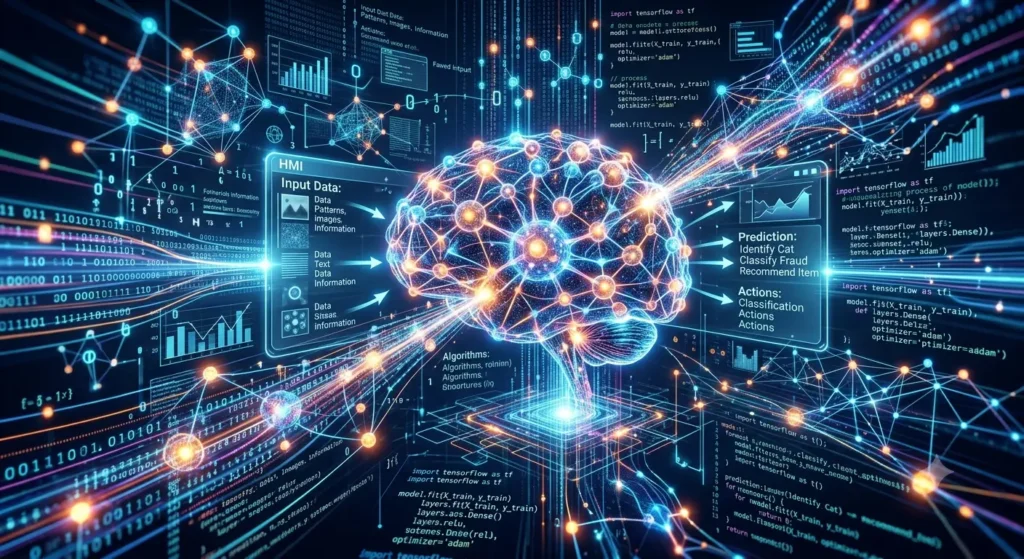
Machine learning is the ability of computers to learn from data. It enables computers to identify patterns and make decisions. Unlike traditional computer programs, machine learning systems get better with experience.
Machine learning is one of the most exciting technologies of our time. It is changing the way people use computers every day. Many tools and services we use today rely on machine learning.
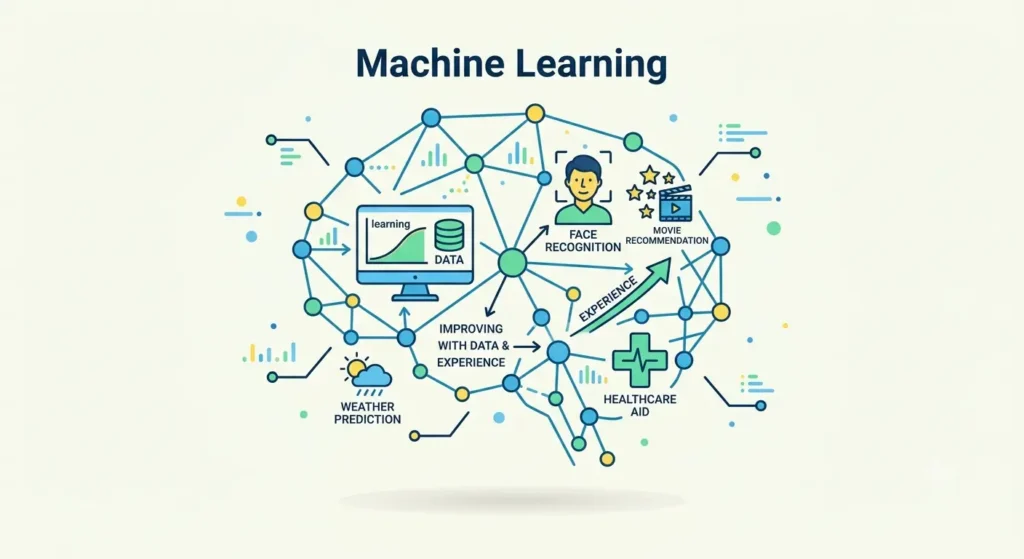
What if a computer could learn from its mistakes, as you do? But what if it could recognize your face, suggest your favorite movie, predict the weather for tomorrow, or even help doctors save lives? This is no science fiction story. This is called machine learning.
Introduction to Machine Learning
Today, machine learning is used in numerous industries. It helps doctors find diseases. Businesses should know their customers. It helps students to learn better. It also helps scientists to find new solutions.
Machine learning is difficult, many people think. Machine learning is teaching computers to learn from examples. An example of machine learning for kids is a child learning to identify a cat by seeing many cats, for example. The child sees different features such as ears and fur. Machine learning is no different. It looks for patterns. It sees instances.
This means that computers can perform tasks that used to require human intelligence. This includes image recognition, language understanding, and prediction.
In this tech world, everybody wants to become a machine learning engineer. Here is the complete machine learning roadmap you need to know. From basic machine learning to advanced concepts, you will also learn about the 4 types of machine learning vs deep learning. If you want to read your interesting topic quickly, follow the table of contents.
What Is Machine Learning?
Machine learning is a subset of AI. It allows computers to learn without being programmed for each specific task. In traditional programming, humans write rules for computers. The computer uses these rules to do a task.
But that’s a different matter, at least when it comes to machine learning. It provides computers with data and examples. The computer studies that information and creates its own patterns.
In machine learning, algorithms are trained on data. An algorithm is a sequence of steps that a computer can use to solve a problem. A spam email filter, for example, uses machine learning. It sorts through thousands of emails. It then identifies which messages are not wanted.
After learning the patterns, the system can identify new spam emails. It continues improving as it receives more information. Therefore, machine learning helps computers become smarter over time.
Machine Learning Definition
Machine learning is a technology that allows computers to learn from data and improve their performance without explicit human instructions. As per computer science experts, machine learning is the development of systems that can learn automatically.
The computer can not think like a human. Instead, it uses mathematical techniques to analyze information. Better data, better machine learning models. The better the data, the better the results, generally. And this is why data is the backbone of machine learning.
History of Machine Learning
Scientists wanted computers to solve problems automatically. Early computers could only follow rigid instructions. They could not learn by experience.
Later on, researchers began to explore artificial intelligence. They wanted machines that could imitate some of the powers of the human mind. In the 1950’s some early learning programs were developed by scientists. These were simple programs, but they laid the foundation for modern machine learning.
One such inflection point came when scientists created algorithms that enabled computers to recognize patterns. Computers became faster. More data was coming in. They came up with better algorithms.
With those improvements, machine learning got more powerful. Machine learning powers many of the technologies used all over the world today.
Why Is Machine Learning Important?
Humans create a huge quantity of data every day. It is difficult for people to go through all this information by hand. Machine learning can quickly process huge amounts of data.
Machine learning helps banks to identify suspicious transactions. This way, financial fraud can be prevented. Hospitals apply machine learning to medical data. It helps doctors make better choices.
Machine learning helps companies understand their customers’ needs. It makes them create better products. Machine learning is also time-saving and reduces human effort. It also improves accuracy in many tasks. Therefore, machine learning has become an integral part of our lives.
How Does Machine Learning Work?
Machine learning works through a simple learning process. First, the computer receives standard data. This can be numbers, images, text, or audio. Next, the machine learning algorithm learns from the data. The algorithm looks for patterns and relationships.
Then it trains a machine learning model. A model is a system that is trained to predict or to make decisions.
After training, the model is tested with new information. If the results are wrong, the system learns from the errors. Over time, the model improves. This is called training machine learning. The more useful data a system receives, the better it can learn.
The Role of Data in Machine Learning
Data is the key part of machine learning. No data, no learning for any machine learning system. Data is like examples for a student. Students learn math by doing problems. Similarly, a machine learning model learns by looking at data.
Machine learning is applied to different kinds of data. Text data like books, emails, and messages. Image data contains both photos and videos. Audio data is made up of songs and voice recordings. Machine-learning systems run this information through to look for patterns.
Better data = better outcomes. Bad data can lead to errors. Accurate data collection is therefore very important.
Machine Learning and Artificial Intelligence
Many people use artificial intelligence and machine learning interchangeably. But these mean different things. Artificial intelligence is a broad field. It’s about building machines that can do intelligent things. Machine learning is a subfield of artificial intelligence.
It allows machines to learn from experience. There are other technologies besides artificial intelligence. These are computer vision, natural language processing, and robotics.
Many AI systems are given the ability to learn through machine learning. Therefore, machine learning is one of the most important parts of artificial intelligence.
Simple Example of Machine Learning
Say you’re teaching a computer to recognize dogs. First, you give lots of pictures of dogs. The computer can view these images. It recognizes common features such as shapes, colors, and patterns.
Then you show another picture. The computer tries to predict if the picture contains a dog. If the answer is wrong, the system learns from the error. After seeing many examples, the computer gets more accurate. This is a straightforward example of machine learning.
Common Examples of Machine Learning in Daily Life
We are already in a machine learning world. Machine learning is employed by search engines to improve their results. Machine learning for video platforms is used for video content recommendation. Online shopping websites use machine learning for recommending products.
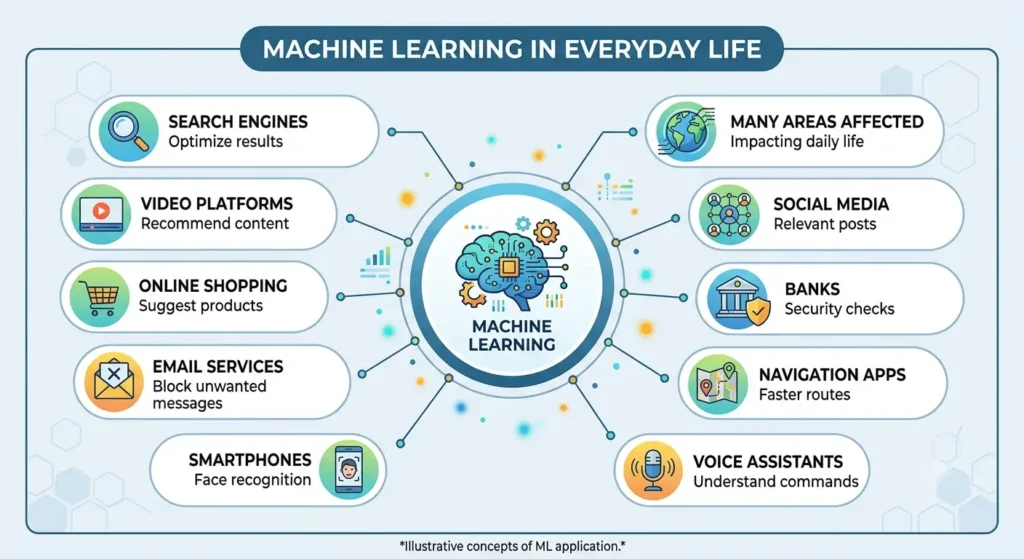
Email services employ machine learning to block unwanted messages. Smartphones use machine learning to recognize faces. Voice assistants use machine learning to recognize your voice. Navigation apps leverage machine learning to recommend faster routes. Banks are using machine learning to check security. Social media platforms use machine learning to show relevant posts. Therefore, machine learning affects many spheres of our lives.
Types of Machine Learning: Understanding Different Types of Machine Learning
There are different learning methods in machine learning. Each method teaches computers in different ways. The main types of machine learning depend on how the computers learn information. Some systems learn from labeled data. Other systems learn patterns without the need for labels.
Some systems learn from punishments and rewards. So each machine learning method has its application.
What are The Four Types of Machine Learning?
- Supervised learning
- Unsupervised learning
- Semi-supervised learning
- Reinforcement learning
These machine learning models help solve different problems. Understanding these types makes machine learning easier to learn.
1: Supervised Learning in Machine Learning
Supervised learning is one of the most popular types of machine learning. Supervised learning is a learning process where the computer learns from data that has been labeled. Labeled data is data that has been tagged with the correct answer.
The computer looks at examples where the outcome is known. And then it uses them to predict new answers. It is similar to how students learn with a teacher.
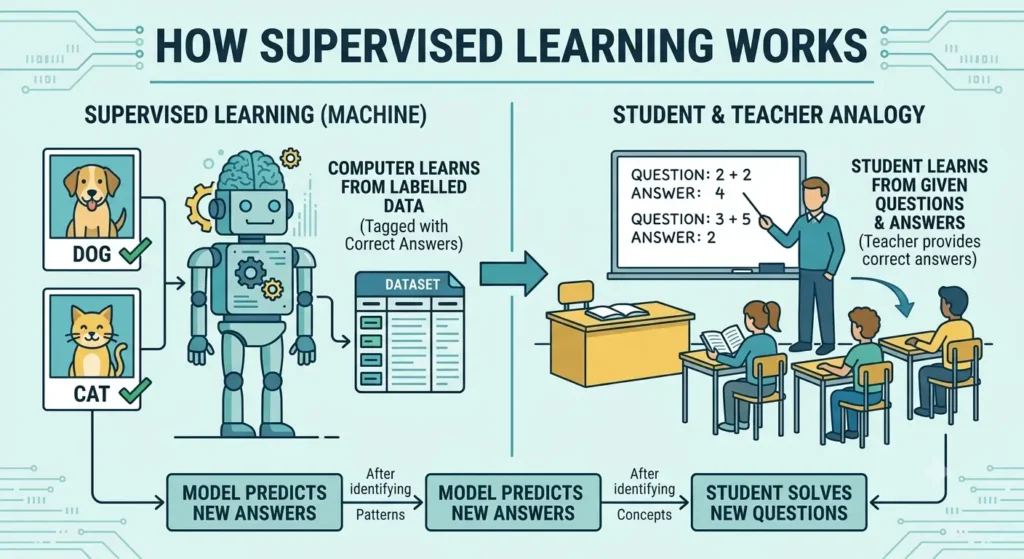
The teacher provides questions and the correct answers. The student reads the given examples. Then the student goes on to solving new questions. Supervised learning is similar.
The machine learning model is trained on a training dataset. The algorithm studies the relationship between information and answers. After learning the patterns, the model makes predictions.
How Supervised Learning Works
Supervised learning consists of a few simple steps. Useful data goes to the humans first. Then they correctly label that data. The labelled data is fed to the machine learning system.
The system learns from examples. Then it trains a machine learning model. The model is evaluated on new data.
If the predictions are wrong, the model learns from it. When trained, the model will be able to make better decisions. This process helps computers do many things.
Examples of Supervised Learning
Supervised learning is applied in a lot of real-world applications. For example, in the domain of email spam detection. The system learns from the emails you label as spam or not spam.
Then it finds new junk messages. Another example is recognizing images. A computer is taught with thousands of labeled pictures. Later, it can identify objects in new pictures. Supervised learning is also used in health care. Machine learning models learn from medical data by physicians.
The system can be used to predict possible health problems. Supervised learning is also used by businesses for sales forecasting. It helps businesses predict future demand for products.
Types of Supervised Learning
Supervised learning has two main categories. These are classification and regression.
1: Classification in Machine Learning
Computers can use classification to organize information. Its output is typically a category. For example, an email could be spam or not spam. It could be a picture of a dog or a cat.
A customer can be interested or not interested. Classification algorithms learn the patterns from the examples in the past. Then they insert the new information into the right category.
Below are common classification algorithms:
- Decision trees
- Support vector machines
- Neural networks
- Logistic regression
These algorithms help computers make accurate choices.
2: Regression in Machine Learning
Regression is a technique used to estimate numerical values. It identifies relationships between various factors. For example, regression can predict future house prices. It can also forecast weather conditions. Businesses utilize regression to estimate future sales figures.
Doctors can apply regression to analyze health metrics. Organizations can make more informed decisions with the assistance of regression.
Some common methods of regression include:
- Linear regression
- Polynomial regression
- Random forest regression
2: Unsupervised Learning in Machine Learning
Another major form of machine learning is unsupervised. In this way, computers learn without having labeled data. The system receives data without the correct responses.
Then it searches for hidden patterns. It finds related things and sorts them out. Learning without being observed is like finding a new world. With help, a person can discover new places.
The person learns by watching what’s going on around them. In the same way, computers identify patterns by analyzing data.
Types of Unsupervised Learning
Unsupervised learning has different methods. The most common methods are clustering and association.
1: Clustering in Machine Learning
Clustering is a way of grouping related information. A computer recognizes common features in data. Then it groups them separately. E.g., a shopping site can cluster customers.
One group is into electronics. Another group might prefer to wear clothes. Business clustering helps in understanding customers.
The most popular clustering algorithms:
- K-means clustering
- Hierarchical clustering
- Density-based clustering
2: Association in Machine Learning
Association is the linking of ideas. It finds what happens most often to each other. The store is one place that uses association learning. The system could learn that people who buy bread also buy milk.
This information assists stores in placing products in the right places. Online stores do the same to make recommendations.
3: Semi-Supervised Learning in Machine Learning
Semi-supervised learning is a combination of supervised and unsupervised learning. It requires a small amount of labeled data. It also leverages a significant amount of unlabeled data. This approach is a useful method when labeling information is time-consuming.
Labeling data may require human experts. So semi-supervised learning saves resources. The system learns from both kinds of information. This results in improved performance compared to training on limited labeled data only.
Examples of Semi-Supervised Learning
Image recognition is often performed using semi-supervised learning. A company could have thousands of images.
Some images have labels. With tags, the machine learning model learns from examples. It then learns patterns from unlabeled images.
Another is speech recognition. Labeling voice data is not simple. Semi-supervised learning improves voice understanding.
4: Reinforcementin Machine Learning
Reinforcement learning works on a reward/error system. The computer learns from interacting with an environment. It performs actions and receives feedback. Do well, and positive outcomes will be rewarded. Unacceptable actions are punished.
As time passes, the system learns better strategies. It’s similar to how a child learns to ride a bike. For example, a child learns to ride a bike. The child does it differently.
The child learns by experience. Similar principles apply to reinforcement learning.
Examples of Reinforcement Learning
Reinforcement machine learning is the basis of many of the most advanced technologies. With reinforcement learning, robots learn to move better. Self-driving cars use similar methods of learning.
Reinforcement learning is used to make computer players intelligent for games. It is also used by researchers to solve complex problems. One well-known example is AI systems that learned to play games. Through repeated practice, these systems became better.
Difference Between Machine Learning Types
For each of the types of machine learning, the learning style is different. For supervised learning, we use labeled examples. Unsupervised learning discovers hidden patterns. Semi-supervised learning is a technique using both labeled and unlabeled data. Reinforcement learning is learning from rewards and actions.
It depends on the problem. The method is selected by the company based on its data. So, it’s important to understand these differences.
Which Machine Learning Method Is Best?
There isn’t one ideal technique to apply machine learning. Occasionally, each way is fine.
- If you have clear examples, supervised learning is a good fit.
- Unsupervised learning is straightforward when trends are found.
- Semi-supervised learning can be useful if you don’t have a lot of labeled data.
- Reinforcement learning is useful when you have a decision to make.
Their method choice is guided by the objective.
How Machine Learning Algorithms Work: A Complete Guide to the Machine Learning Process
Introduction to Machine Learning Algorithms
Machine learning algorithms are the building blocks of machine learning systems. They help computers learn from data. An algorithm is a set of instructions for a computer to solve a problem.
Humans use algorithms every day. For example, a recipe is an algorithm for preparing food. These are the steps to complete a task. In machine learning, an algorithm helps computers discover patterns.
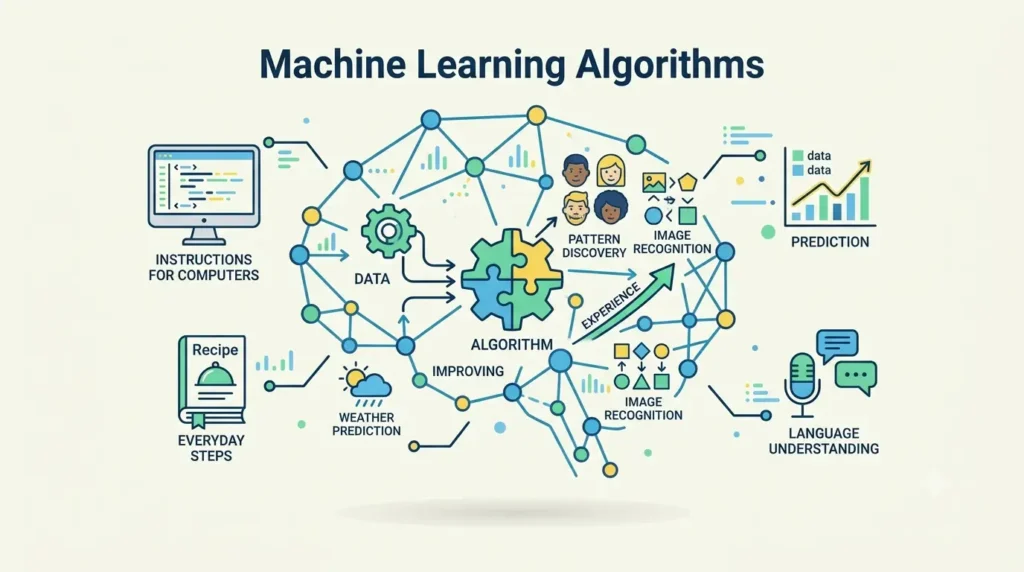
It helps computers understand information. It also helps computers make predictions. Different problems require different machine learning algorithms. Some algorithms recognize images. Some algorithms predict future events. Some algorithms understand human language. Therefore, choosing the right algorithm is important.
What Are Machine Learning Algorithms?
Mathematical methods are called machine learning algorithms. They give computers examples to learn from. These algorithms build models from data. A model is a self-disciplined computer system that can resolve problems. The program gets smarter by using training data.
After learning something, it uses what it has learned to deal with new information. One example of a machine learning program is looking at sales data from the past. By noticing patterns, it can guess what sales will happen in the future. Businesses can make better choices with this information.
The Machine Learning Process Step by Step
Machine learning follows several important steps. Understanding these steps makes machine learning easier.
Step 1: Collecting Data
The first step is collecting data. Data is the information used for learning. The data can come from different sources. Companies collect customer information. Hospitals collect medical records. Weather stations collect climate information. The quality of collected data affects the final results. Therefore, accurate data collection is very important.
Step 2: Preparing Data
Raw data is often not ready for machine learning. It may contain errors or missing information. Data preparation solves problems. This is called data cleaning. Machine learning models are improved on clean data.
Data scientists organize information before training. They also remove unnecessary information. As a result, the algorithm receives better input.
Step 3: Choosing a Machine Learning Algorithm
The next step is selecting an algorithm. Different problems need different algorithms. For example, image recognition needs different methods than sales prediction.
Machine learning engineers choose algorithms based on the goal. They also consider the amount of available data. The right algorithm improves performance.
Step 4: Training the Machine Learning Model
Training is one of the most important steps. During training, the algorithm studies the data. It learns relationships between different information.
The model makes predictions. Then it compares results with correct answers. If mistakes happen, the model adjusts. This process repeats many times. Eventually, the model becomes more accurate.
Step 5: Testing the Model
Once trained, the model needs testing. Checking the performance of the model. Evaluation on new data.
The model must be able to generalize to data it has not seen. A good machine learning model produces accurate results. Experts test to find weaknesses. They can improve the model before actual use.
Step 6: Using the Machine Learning Model
Once testing goes well, the model is put into use. Deployment is applying the model to real situations. For example, a recommendation system may recommend products.
A health care model can be used to analyze medical information. A security system can identify abnormal activity. The model continues to learn from new data. That means machine learning systems can improve over time.
What are the Popular Machine Learning Algorithms
1: linear regression algorithm
Linear regression is a popular algorithm for machine learning. The main use is for prediction-related tasks. It studies relationships between different variables.
For example, it can predict housing prices. It can also predict a business’s sales. The algorithm finds relationships between the input and output information. It then uses those patterns to forecast the future. Linear regression is a simple and popular technique.
2: Logistic Regression Algorithm
For classification problems, we use logistic regression. It helps computers to sort information into categories. For example, it can classify emails into spam or safe.
It can also predict if a customer may buy a product. Logistic regression is a classification technique, despite the name. It is very useful for many decision-making tasks.
3: Decision Tree Algorithm
A decision tree algorithm works like a flow chart. It makes decisions by following different paths. Each question creates a new way.
The final result appears at the end. For example, a decision tree can identify whether an animal is a cat or dog. It checks features like size, color, and shape. Decision trees are easy to understand. Therefore, many beginner machine learning experts learn them first.
4: Random Forest Algorithm
A collection of several decision trees is called a random forest. To achieve better outcomes, a random forest combines the predictions of several decision trees. Every tree predicts something.
The system selects the best overall response. Errors are decreased with random forests. It is applied to problems involving prediction and categorization. This algorithm is used in many sectors.
5: Support Vector Machine Algorithm
A support vector machine is also known as an SVM. It allows different groupings of information. The algorithm defines a boundary between classes. For example, it can distinguish between different types of images.
SVM is useful for classification. It works nicely with complex data.
6: K Means Clustering Algorithm
K-means is an unsupervised learning algorithm. It groups similar information. The algorithm finds patterns without labeled answers.
For example, businesses use it to group customers. The algorithm groups customers with similar interests together. This helps companies create better strategies.
Neural Networks in Machine Learning
Neural networks are advanced machine learning methods. The human brain serves as an inspiration for them. The human brain has connected cells called neurons. Neural networks use artificial neurons.
These neurons process information. They learn complex patterns from large amounts of data. Neural networks power many modern technologies. It helps computers recognize images and understand speech.
Deep Learning and Machine Learning
Deep learning is a special area of machine learning. It uses large neural networks. Deep learning systems have many layers. These layers help computers understand complex information. Deep learning is used in advanced applications.
Examples include:
- Self-driving cars
- Voice recognition
- Medical image analysis
- Language translation
Deep learning has improved artificial intelligence greatly.
Training Data and Testing Data
Machine learning models need two types of data. These two types of data are training data and testing data. The training data teaches the model. Testing data tests the model.
It can cause problems to use the same data for both tasks. The model can memorize information rather than learn patterns. This phenomenon is called overfitting. So, separation of data is important.
Overfitting in Machine Learning
Overfitting occurs when a model learns too much from the training data. The model performs well on previously seen data. But it’s no longer effective with new information. It’s like studying the answers to a test.
When questions change, the student may fail. Machine learning experts use different techniques to avoid overfitting. These techniques improve the model performance.
Underfitting in Machine Learning
Underfitting happens when a model does not learn enough. The model cannot understand important patterns. As a result, it gives poor results. Experts improve underfitting by using better algorithms. They may also provide more useful data. Finding the right balance is important.
Advantages Disadvantages and Real-World Applications of Machine Learning
Introduction to Machine Learning Applications
Machine learning has been a key technology in many fields of life. It helps people with challenging problems. It allows computers to process large amounts of data.
Today, machine learning is used by businesses, governments, schools, and researchers. Machine learning becomes more important with the increase in digital data. Millions of devices create new data every day.
Machine learning helps us understand this information. This allows organizations to make better decisions. With advancements in technology, machine learning applications keep expanding.
Advantages of Machine Learning
- Machine learning provides many benefits.
- It helps people complete tasks faster.
- It improves accuracy.
- It reduces human effort.
- It helps discover hidden patterns in data.
- It supports better decision-making.
- Therefore, many industries are adopting machine learning.
1: Faster Data Analysis with Machine Learning
Machine learning has a major advantage in the speed of data processing. It is difficult for humans to examine millions of records. Machine learning systems can process large volumes of information at high speed.
For example, banks process thousands of transactions in a second. Unusual activity is flagged by machine learning. It saves time and adds a layer of security. Similarly, companies study customer information rapidly. They use these insights to improve their services.
2: Improved Accuracy Through Machine Learning
A lot of things can be done more accurately with machine learning. Computers can see what people can’t. For example, you can use machine learning to analyze medical images.
It can help doctors detect potential health problems. It may also help with speech recognition systems. Machine learning improves the ability of today’s voice assistants to interpret human commands. The accuracy, on the other hand, depends on good data and the right training.
3: Automation Through Machine Learning
Robots can do boring tasks more quickly and easily with the help of machine learning. Automation means completing work with less human involvement. For example, companies use chatbots for customer support.
Such systems automatically respond to frequently asked questions. Manufacturing companies employ machine learning robots. These robots check products and improve production. Automation saves time and reduces workload.
4: Better Decision Making with Machine Learning
Machine learning helps businesses make smart choices. It looks at data from the past. Thereafter, it predicts what might happen in the future.
- Businesses use these predictions to plan.
- Doctors use data analysis to support medical decisions.
- Scientists use machine learning to tackle complex problems.
Machine learning helps make smarter decisions.
5: Personalized Experiences Through Machine Learning
With machine learning, you can get a personalized experience. It analyzes user behavior. Then it suggests things you might be interested in.
- For example, video platforms suggest content.
- Websites that sell stuff will recommend things to buy.
- Apps Suggest Songs.
These systems are powered by machine learning algorithms. They know user preferences and enhance user experience.
Disadvantages of Machine Learning
Machine learning has many benefits but also many challenges. It is critical to have a solid understanding of these constraints. Quality data are needed by machine learning systems. Data must be properly managed. It can also create ethical concerns.
1: Need for Large Amounts of Data
- Computer programs that use machine learning need data to learn.
- Some systems require millions of examples.
- Gathering and structuring data can be difficult.
- Poor data can create inaccurate results.
- Hence, organizations need to focus on data quality.
- A good data set is the foundation of a good machine learning model.
2: High Development Costs of Machine Learning
It can be expensive to build machine learning systems. Companies need qualified people. They require advanced computers. They also require powerful software tools.
Small organizations may face challenges. But technology is more widely accessible. Many affordable machine learning tools are now available.
3: Machine Learning Bias Problems
Machine learning systems are trained on existing data. If data contains unfair patterns, the machine may repeat them. This problem is called machine learning bias.
For example, an inaccurate dataset can affect forecasts. Experts are working to develop fair and balanced systems. Responsible development is crucial.
4: Privacy Concerns in Machine Learning
- Machine learning often relies on personal data.
- That could be a little risky for privacy.
- User data must be protected by companies.
- They have to be doing security right.
- Users should understand the data used.
- Trust is built on responsible data handling.
Machine Learning in Different Industries
Machine Learning in Healthcare
Machine learning is used in many important areas, including healthcare. Machine learning is used by doctors and researchers to enhance patient care. Medical images can be analyzed by machine learning.
- It can be used to diagnose disease.
- It can learn from patients’ data.
- It can forecast health risks.
For example, machine learning systems can help identify problems in X-rays and scans. Doctors use these tools as support. They do not replace human medical experts.
Machine Learning in Disease Detection
Early detection of disease can save lives. Machine learning can speed up the rate of medical data analysis.
It can detect patterns related to health. Machine learning is used for cancer research. They also use it to investigate heart disease. These systems assist doctors in making better decisions.
Machine Learning in Drug Development
It takes years to develop new drugs. Machine learning is helping researchers make sense of chemical information. It can recognize possible combinations of drugs. That saves time in research. Pharmaceutical companies use machine learning to improve drug discovery.
Machine Learning in Business
Businesses use machine learning in various ways. It helps companies to understand their customers. It enhances marketing strategies. It is used to predict sales trends.
It’s a fraud detector. It enhances customer service. Machine learning gives companies valuable insight.
Machine Learning in Marketing
Machine learning has revolutionized marketing. Companies analyze consumers’ behaviors. They know what people want. Then they make better advertising.
Machine learning will provide you with what you want to see. It builds customer engagement. This is why a lot of marketers use tools that use machine learning.
Machine Learning in Finance
Machine learning is essential to financial institutions. Banks use it to detect fraud. It detects anomalous payments. Machine learning also plays a role in risk analysis. Investment companies make choices based on predictions. These systems enhance financial security.
Machine Learning in Education
AI in education is also helping to make education better. Technology is used in schools for the improvement of learning. Machine learning can personalize education.
It reveals the strengths and weaknesses of the student. Teachers can more easily monitor student progress. Learning platforms are integrating machine learning recommendations online. These strategies allow students to learn at their own pace.
Machine Learning in Transportation
Another major area of discussion is transportation. Machine learning is improving travel systems. Machine learning is used in navigation apps.
These applications examine data on traffic. Then recommend better ways. Self-driving vehicles also use machine learning. Also recognize objects and understand the status of the route.
Machine Learning in Agriculture
Machine learning is helping farmers for better farming
It is useful in crop monitoring.
- It can predict the weather.
- It detects diseases of plants.
- It enhances water management.
Machine learning is helping farmers to increase production.
Machine Learning in Cybersecurity
Cybersecurity protects computers and networks. Machine learning helps detect threats. It studies unusual activities. It identifies possible attacks. Security companies use machine learning to improve protection.
Machine Learning in Entertainment
Entertainment platforms are using machine learning every day. Movie/show recommendations for streaming services. Music platforms recommend songs. Gaming companies make the experiences more intelligent. Machine learning makes digital content more enjoyable for people.
Machine Learning in Smart Devices
A lot of smart devices use machine learning. Smartphones use it for face recognition. It is used by cameras to enhance images.
It is used in voice commands for smart speakers. Home devices learn the habits of the users. So machine learning is taking over in our lives.
The Future of Machine Learning
Machine learning has a very bright future. The technology is improving every day. Machine learning will be adopted by more industries. Computers will understand information better.
Machine learning will help us make discoveries. Healthcare, transportation, education, and business will continue to evolve. But it will still be important to develop responsibly. Experts should focus on safety, fairness, and privacy.
Machine Learning Career Opportunities Skills Tools and Future Trends
Machine learning is creating many new career opportunities across the world. Companies need people who can build and operate machine learning systems. With the growth of technology, the demand for machine learning experts is on the rise.
Many industries now use machine learning. Healthcare companies use machine learning for medical research. Banks use it for security. Tech companies use it for smart applications. For smart applications by tech companies. So, machine learning can open many career paths.
To work in machine learning requires technical knowledge and problem-solving skills. Beginners can learn the basics and build skills gradually.
Machine Learning Engineer Career
A machine learning engineer builds and maintains machine learning systems. This professional is responsible for designing algorithms and training machine learning models.
Machine learning engineers deal with big data sets. They address technical problems and increase model performance.
They also collaborate with software developers and data scientists. They are on a mission to build useful machine learning applications.
Many tech companies hire ML engineers. by many tech companies. The artificial intelligence is still growing, so this career has great growth potential.
Data Scientist and Machine Learning
Data scientists collaborate closely with machine learning technology. They analyze information and identify useful patterns.
They collect data and prepare it for use in machine learning models. They also produce reports that assist organizations in decision-making.
A data scientist should be familiar with programming and data analytics.
For modern data scientists, machine learning is one of the most important skills.
Artificial Intelligence Researcher
Researchers in artificial intelligence look for new ways to make machine learning systems better. They invent new methods and experiment with new ideas.
Tech companies employ researchers, who also belong to study groups associated with universities. They discuss computer vision, deep learning, natural language processing, and more. This is the kind of work for people who enjoy science and new ideas.
Machine Learning Developer
Machine learning developers develop software applications using machine learning technology. They integrate machine learning models into websites, mobile apps, and business systems.
For example, a developer might build a recommendation engine for an online store. They require knowledge of programming and machine learning concepts.
Skills Needed for Machine Learning
Learning machine learning requires a different skill set. Technical skills matter. But problem-solving and creativity are also important. Technology evolves rapidly therefore, a successful machine learning professional is always learning. Here is a list of important skills that you need to know before you start learning.
Most Important Machine Learning Skills for Beginners
- If you are just starting your machine learning journey, focus on these skills first:
- Python Programming
- Mathematics Basics
- Statistics
- SQL
- Data Cleaning
- Data Visualization
- Exploratory Data Analysis (EDA)
- Supervised Learning
- Unsupervised Learning
- Scikit-learn
- TensorFlow
- PyTorch
- Neural Networks
- Deep Learning
- Model Evaluation
- Feature Engineering
- Git and GitHub
- MLOps Basics
- Cloud Computing Basics
- Communication and Problem Solving
- These skills provide a strong foundation for becoming a machine learning engineer, data scientist, AI engineer, or how to become an artificial intelligence specialist.
What is the Difference Between Machine Learning and Artificial Intelligence
Artificial intelligence is closely related to machine learning. But they are not quite the same. Artificial intelligence is a vast field. It is about making machines that can do intelligent things.
Machine learning is a field of AI. It’s a way for computers to learn from data. Artificial intelligence is used in things like voice assistants. Machine learning helps it understand speech and improve responses. Therefore, machine learning is one method used to create intelligent systems.
What is the Difference Between Machine Learning and Deep Learning
Deep learning is a subset of machine learning. Different algorithms are used in machine learning to learn from data. Deep learning uses artificial neural networks with many layers.
Deep learning is good with complex data. For example, deep learning is commonly used for image recognition and language understanding. Machine learning uses smaller data sets. Deep learning usually requires larger amounts of data. Both are important technologies in modern AI.
Future Trends of Machine Learning
The future of machine learning will continue growing. New technologies will provide more power to ML. Industries will use smarter systems in many ways.
Some of the key trends for the future:
- Generative AI
- Automated machine learning
- Advanced robotics
- AI healthcare systems
- Smart transportation
- Personalized education
These technologies will change how people work and live.
Frequently Asked Questions About Machine Learning
Machine learning is a technology that allows computers to learn from data. It allows computers to see patterns and make decisions. When the system gets more useful information, it gets better. Machine learning is a part of artificial intelligence.
The process of machine learning involves the analysis of data. A computer applies algorithms to detect patterns.
Then it builds a model. The model predicts according to the learned patterns. The system improves through training and testing.
There are four main types of machine learning:
Supervised learning.
Unsupervised learning.
Semi-supervised learning.
Reinforcement learning.
Each method helps computers learn in different ways.
No. Machine learning and artificial intelligence are connected. But both are different technologies. Artificial intelligence is the larger field. And ML is one part of artificial intelligence.
Machine learning helps solve complex problems. It improves speed and accuracy and helps businesses make better decisions.
It supports healthcare research.
Machine learning is used in many areas, including:
Healthcare.
Finance.
Education.
Transportation.
Agriculture.
Marketing.
Cybersecurity.
Entertainment.
Smart devices.
Machine learning can be very challenging. But beginners can learn it with practice. It’s easier to learn if you start from the basics. Useful skills in programming, math, and data. Practice makes perfect.
Python is the most popular language for machine learning.
Machine learning is a form of learning from data using algorithms. Deep learning is a subset of machine learning.
Artificial neural networks are used in deep learning. It is good for complex tasks.
Machine learning is going to change many jobs. Some tasks may become automated. However, new career opportunities will also appear. Humans will continue to play an important role. Machine learning works best when combined with human skills.
Conclusion
Machine learning is the most advanced and powerful technology in the modern digital world. It helps computers learn from data and complete tasks more effectively. Many industries and businesses depend on machine learning nowadays.
Industries that depend on machine learning include healthcare, education, finance, and transportation. That’s helping humans and solving real problems. Technology is advancing rapidly. Also, the importance of ML has increased in our everyday lives.
Learning ML may seem difficult in the beginning. But anyone can understand and learn if he is starting from the basics. More practice will help you become an AI specialist.
The future of machine learning is bright, with new technologies growing fast. Such as generative AI, robotics, and intelligent automation. If you want to become an AI expert and machine learning engineer, you need to learn skills that are in demand.
Thank you for reading this complete guide on machine learning. I hope this interesting article will help you start machine learning and the basics of ML and its importance. Your journey starts with one small step. And every lesson you learn brings you closer to becoming an AI professional.
Research References
- Samuel, A. L. (1959). Some Studies in Machine Learning Using the Game of Checkers. IBM Journal of Research and Development.
https://ieeexplore.ieee.org/document/5392560 - Mitchell, T. M. (1997). Machine Learning. McGraw-Hill Education.
https://www.cs.cmu.edu/~tom/mlbook.html - Goodfellow, I., Bengio, Y., & Courville, A. (2016). Deep Learning. MIT Press.
https://www.deeplearningbook.org - LeCun, Y., Bengio, Y., & Hinton, G. (2015). Deep Learning. Nature, 521(7553), 436–444.
https://www.nature.com/articles/nature14539 - Andrew Ng. Machine Learning and AI Education. Stanford University and DeepLearning.AI.
https://www.andrewng.org - Google Research. Machine Learning Research Publications.
https://research.google - IBM Research. Artificial Intelligence and Machine Learning.
https://research.ibm.com/artificial-intelligence - Microsoft Research. Artificial Intelligence Research.
https://www.microsoft.com/research/research-area/artificial-intelligence - MIT Computer Science and Artificial Intelligence Laboratory (CSAIL).
https://www.csail.mit.edu - Stanford Artificial Intelligence Laboratory (SAIL).
https://ai.stanford.edu - Scikit-learn Documentation. Machine Learning in Python.
https://scikit-learn.org - TensorFlow Documentation. Open Source Machine Learning Framework.
https://www.tensorflow.org - PyTorch Documentation. Deep Learning Framework.
https://pytorch.org