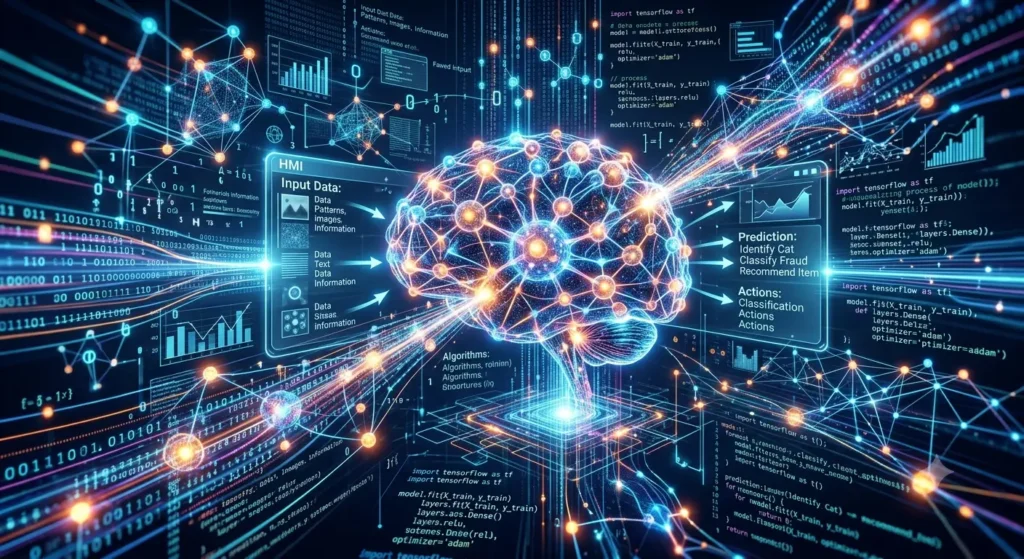
Deep learning is a branch of machine learning that uses artificial neural networks to enable computers to learn from large amounts of data. It enables computers to identify patterns and to make decisions without direct human instructions.
Introduction to Deep Learning in Machine Learning
Deep learning is one of the most powerful fields in artificial intelligence today. It allows machines to learn from experience and improve with time.
Ever wonder how your phone recognizes your face or how AI recognizes your voice? These amazing technologies, made possible by deep learning, are changing how humans use computers.
There have been applications of deep learning in different fields of artificial intelligence. It helps in healthcare, education, business, transportation, and entertainment. They are aware that deep learning helps people understand the future of technology.
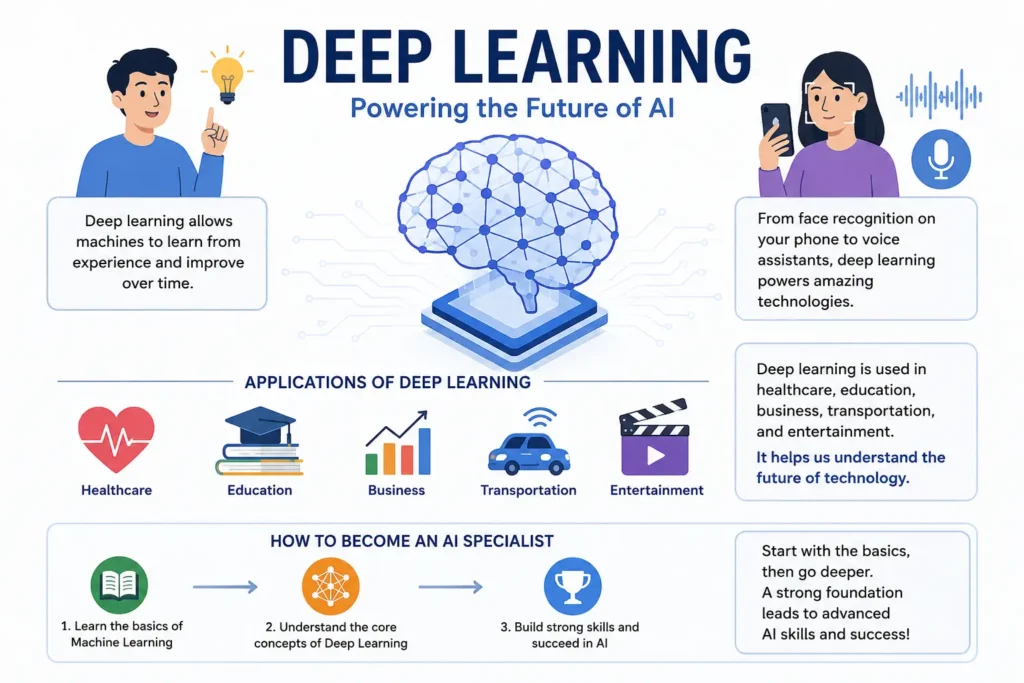
If you want to become an AI specialist, start by learning the fundamentals of machine learning. Once you understand those basics, move on to the core concepts of deep learning. A strong foundation in both will help you build advanced AI skills and succeed in the field.
- How to become an AI specialist a complete word-by-word guide for beginners
- What is machine learning a complete beginner’s guide
What Is Machine Learning?
Machine learning is a subset of artificial intelligence that enables computers to learn from data. Instead of programming machines with fixed instructions, they are trained to study information and find patterns. They are trained to study information and find patterns. First, build a machine learning model from data. Then it analyses the data. It then makes predictions or decisions.
For example, a machine learning system can study thousands of emails. It learns which messages are junk. Then it can block unwanted emails automatically.
Machine learning uses different methods to resolve problems. The methods are called supervised learning, unsupervised learning, and reinforcement learning. But machine learning is a more advanced subset of deep learning. It learns challenging tasks by using complex things called neural networks.
What Is Deep Learning in Machine Learning?
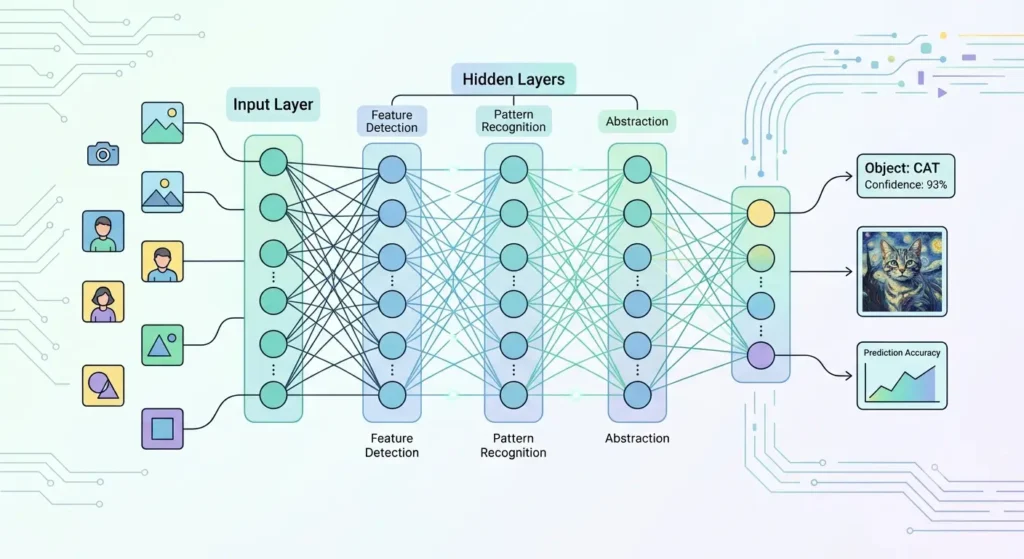
Deep learning is a type of machine learning that relies on a series of layers of artificial neural networks. These layers allow computers to learn complex patterns from data.
The deep learning model can process various types of information. It can understand pictures, videos, text, sounds, and numbers.
For example, a computer vision system can identify objects in an image. A natural language processing system is capable of understanding human language. A voice recognition system can translate voice into text.
DL systems differ from traditional machine learning algorithms in that they can automatically discover important features from raw data. DL has therefore become a key technology in modern AI systems.
What Is the Difference Between Deep Learning and Machine Learning?
How machine learning and deep learning learn from data is the main difference between them.
To choose key features from data, machine learning models typically require human intervention. Deep neural networks enable deep learning models to automatically learn features. If a machine learning system discovers animals, it might require specialists to provide further information on their size or shape.
But a deep learning model can look at thousands of images and figure out what parts of them are important. Therefore, compared to traditional machine learning techniques, deep learning requires less human supervision.
Deep Learning vs Machine Learning Comparison Table
| Machine Learning | Deep Learning |
|---|
| Machine learning is a branch of artificial intelligence. | Deep learning is a specialized part of machine learning |
| Uses simpler algorithms | Uses deep neural networks |
| Works well with smaller datasets | Needs large amounts of data |
| Often requires human feature selection | Learns features automatically |
| Requires less computer power | Requires powerful hardware |
| Training is usually faster | Training can take more time |
| Easier to understand | More complex to explain |
| Good for simple prediction tasks | Good for complex tasks |
How Deep Learning Works
Artificial neural networks are used in deep learning. The way the human brain processes information serves as an inspiration for these networks. Neurons are interconnected units that make up a brain network. Together, these neurons analyze data.
Typically, a deep neural network consists of three primary components:
1: Input Layer
The input layer receives information from the external world. For example, it could be an image, a sentence, or a sound file.
2: Hidden Layers
The hidden layers work in steps, processing information. The data is learned by different features in each layer.
Simple details might be at the first layer. The layer above may be able to understand more complex patterns.
2: Output Layer
The last layer produces the output. For example, it can be used to identify an object in an image or answer a question.
Why Is Deep Learning Called Deep Learning?
Because deep learning uses many layers in a neural network, it is known as deep learning. There are typically fewer processing steps in traditional machine learning models.
Deep learning models, however, include many hidden levels. These layers allow computers to understand complicated information. A DL model that can recognize a person’s face, for example, goes through several steps.
- It first recognizes basic lines.
- It then recognizes shapes and eyes.
- It then recognizes facial features.
- At last, the entire face is recognized.
- This procedure helps achieve high accuracy in deep learning.
How Does a Deep Learning Model Learn?
A deep learning model increases its knowledge through a process named training.
- The model is trained on a large dataset.
- The dataset provides examples to learn.
- First, the model predicts.
- It compares its output with the correct answers.
- Then it self-corrects to make fewer mistakes.
- This process is repeated many times until the model improves.
So, deep learning systems get better with better data and training.
The Role of Data in Deep Learning
Deep learning is built on data. To train effectively, a deep learning system requires a lot of high-quality data.
This information may consist of:
- Pictures
- Videos
- Text documents
- Recordings of audio
- Details about the customer
- Health records
A model’s ability to recognize patterns improves with the amount of valuable data it gets. But data quality is also crucial. Bad data can lead to bad effects. So, data scientists carefully organize and prepare information before it is used to train AI models.
Deep Learning Applications in Real Life
Deep learning is already in everyday life. DL is the foundation of many technologies used by people today.
1. Facial recognition
Face unlock in smartphones is done using deep learning. The system studies facial patterns and identifies the right person.
2. Voice Assistants
Artificial intelligence and natural language processing are used by voice assistants. They can understand words spoken to them and respond with useful information.
3. Online Recommendations
Deep learning models are used by streaming platforms and online stores. They monitor user activity and recommend relevant content.
4. Medical Technology
Doctors use deep learning for the analysis of medical images. It helps in diagnosing diseases from X-rays and scans.
5. Self-Driving Cars
Deep learning and computer vision are used by autonomous vehicles. They know about roads, objects, and traffic.
Deep Learning in Artificial Intelligence
Deep learning is one of the most important technologies in AI. Many traditional artificial intelligence systems are dependent on pre-programmed rules. But with deep learning, systems can learn from experience.
Modern AI applications use deep learning:
- Image identification
- Language translation chatbots
- Generative AI
- Recommendation engines
- Prescriptive analytics
So deep learning is helping to build more useful and smarter AI solutions.
Deep Learning and Generative AI
Generative AI is another important area connected with deep learning. Generative AI systems can create new content.
They can generate:
- Text
- Images
- Music
- Videos
- Computer code
These systems use advanced deep learning models. Large language models are examples of deep learning technology. They use huge amounts of text data to understand and generate human-like language.
Why Deep Learning Is Important for the Future
Deep learning is helping machines solve problems. DL helps computers perform tasks that once required human intelligence. In the future, deep learning may improve.
- Healthcare systems
- Scientific research
- Education tools
- Business automation
- Climate studies
- Robotics
As technology grows, deep learning will continue to influence our daily lives.
Key Points About Deep Learning
- Deep learning is a part of machine learning.
- It uses artificial neural networks.
- It learns from large datasets.
- It finds complex patterns automatically.
- It supports modern artificial intelligence systems.
- It powers many technologies people use daily.
- It continues improving with better data and research.
Types of Deep Learning Models in Machine Learning
Deep learning solves different problems with different models. Every deep learning model is designed for a specific task. Some models get pictures. Some understand human language. Others create new content.
These models are based on artificial neural networks. They learn from huge amounts of data, and the more they practice, the better they get. So each model becomes more accurate over time. Learning these models helps you understand how machine learning powers modern artificial intelligence.
What Is a Deep Learning Model?
Deep learning models are computer programs that learn from data. It studies many examples before making decisions. The model searches for patterns in the data. It then uses these patterns to predict.
For example, a deep learning model can learn to identify animals. It studies thousands of pictures first. Then it learns correctly about new animals. A deep learning model automatically learns many features, unlike many traditional machine learning algorithms.
Main Types of Deep Learning Models
There are many deep learning models. However, a few models are used most often.
They include:
- Feedforward Neural Networks
- Convolutional Neural Networks
- Recurrent Neural Networks
- Long-Short-Term Memory Networks
- Transformer Models
- Autoencoders
- Generative Adversarial Networks
Each model has a different purpose.
1: Feedforward Neural Networks
A feedforward neural network is the simplest type of artificial neural network. Information moves in one direction. The data enters the input layer. Next, it moves through hidden layers. Finally, it reaches the output layer. This model cannot remember past information. Therefore, it works well for simple prediction tasks.
Common Uses:
- Number prediction
- Customer classification
- Risk analysis
- Basic pattern recognition
Although this model is simple, it helped create many modern DL systems.
2: Convolutional Neural Networks (CNN)
CNN is also known as a convolutional neural network. A CNN is for computer vision tasks. It sees pictures by looking at little bits first. It then takes those pieces and reassembles them into a complete picture.
For example, a CNN first learns edges. Then it searches for shapes. Then it detects full objects. Finally, it identifies the correct image. Due to this process, CNN models achieve accuracy.
Common Uses:
- Face recognition
- Medical image analysis
- Self-driving cars
- Security cameras
- Satellite images
- Product inspection
Today, many image recognition systems depend on CNN technology.
3: Recurrent Neural Networks
An RNN is a Recurrent Neural Network. Unlike CNN models, RNN models recall previous information. This memory helps the model to understand sequences.
For example, each word in a sentence depends on previous words. This information is used to learn by an RNN. This led to the popularization of RNN models in natural language processing.
Common Uses:
- Language translation
- Speech recognition
- Text prediction
- Chatbots
- Music generation
Although RNN models are powerful, they sometimes struggle with long-term information.
4: Long Short Term Memory Networks
LSTMs are long short-term memory networks. They are improved versions of RNN models. Long- and short-term memory networks are better at remembering the important bits. They solve many memory problems present in older RNN models.
Common Uses:
- Voice assistants
- Language translation
- Text generation
- Weather prediction
- Financial forecasting
Many modern AI models still use LSTM technology for sequence learning
5: Transformer Models
Transformer models have completely transformed the machine learning world. They can process plenty of words at a time. So they are much quicker than the older models. Transformers are also better at understanding relationships between words.
Many of the advanced large language models today use Transformer technology. These models may provide answers to your questions.
- They can sum up articles.
- They can create stories.
- They can translate languages.
- They can help programmers write code, too.
Those abilities are the heart of modern generative AI, which is based on transformers.
Common Uses:
- AI chatbots
- Language translation
- Text summarization
- Content creation
- Search engines
- Virtual assistants
Many modern AI tools use Transformer-based deep learning models every day.
6: Autoencoders
Autoencoders are a class of deep learning models. They learn to compress data. Later, they reconstruct the original information. This process helps the model learn important features.
- Common Uses:
- Image compression
- Noise reduction
- Medical research
- Data science
- Pattern recognition
Autoencoders are useful for large datasets.
7: Generative Adversarial Networks
GANs are a type of generative adversarial network. GANs consist of two neural networks. One network produces new content. The quality is checked by the other network.
Both networks are still learning together. This makes the output of generated content very realistic. Generative AI now relies heavily on GANs.
- Common uses:
- AI-generated images
- Video Productions
- Art production
- Medical studies
- Game design
Every day, GAN technology is improving.
How Deep Learning Models Learn
Every deep learning model follows a learning process.
Step 1
The model receives a dataset.
Step 2
The dataset moves through the neural network.
Step 3
The model makes a prediction.
Step 4
The prediction is compared with the correct answer.
Step 5
The model adjusts its internal values.
Step 6
The learning process repeats many times.
Eventually, the model becomes more accurate.
What Is a Dataset?
A data set is a group of data. Deep learning models require datasets to train on.
Datasets may contain:
- Pictures
- Videos
- Sound
- Words
- Numbers
- Medical Files
Better datasets = better AI systems.
Thus, data science is about collecting clean and useful data.
What Is Training in Machine Learning?
Training means training the deep learning model. During training, the model is shown many examples. It learns from each mistake. Then it self-improves. Training can take hours, even weeks.
The training time depends on:
- Data set size
- Complexity of the model
- Computing power
- Training method
What Is an Epoch?
An epoch is a whole learning cycle. One epoch refers to the model having seen every example in the dataset once. Generally, each epoch will improve the model accuracy. Most deep learning initiatives require lots of epochs.
What Is a Loss Function?
A loss function catches errors. It figures out how wrong the model was. High loss is lots of errors. Better success means less loss. Hence, the goal is always to minimize the loss value.
What Is an Optimizer?
An optimizer helps improve learning. It changes the neural network after every mistake.
Popular optimizers include:
- Adam
- SGD
- RMSProp
These optimizers help deep learning models learn faster.
What Are Activation Functions?
Neural networks use activation functions to aid in decision-making. Complex problems cannot be solved by deep learning without activation functions.
Typical activation functions consist of:
- ReLU
- Sigmoid
- Tanh
These functions improve learning inside hidden layers.
What Are Hyperparameters?
Hyperparameters control how a model learns. They are chosen before training begins.
Examples include:
- Learning rate
- Batch size
- Number of epochs
- Number of hidden layers
Choosing the right hyperparameters improves model performance.
Why Different Deep Learning Models Matter
Each deep learning model solves different problems.
- CNN models understand images.
- RNN and LSTM models understand sequences.
- Transformer models understand language.
- GAN models can produce new content.
- Autoencoders find hidden patterns.
So the business will choose different machine learning models for different purposes.
How Deep Learning Is Used in Real Life
Deep learning can be part of your life every day, if you want it to be.
- Deep learning is used in your smartphone.
- Deep learning is used by search engines.
- Deep learning is used by streaming services.
- Deep learning is also used by online stores.
These systems learn user behavior. Then they get improved results over time. Read the Machine Learning Applications of Deep Learning guide in its entirety if you’d like.
Benefits of Deep Learning Applications
Deep learning offers many advantages.
Major Benefits
- High accuracy
- Fast decision-making
- Better automation
- Improved customer experience
- Strong pattern recognition
- Continuous learning
- Better predictions
- Time savings
- Lower operating costs
- Smarter AI systems
Therefore, organizations across the world continue investing in deep learning.
Challenges of Deep Learning Applications
But deep learning is not without its challenges. Learning about these challenges will help people create better AI systems.
- General problems
- Need large datasets.
- It takes time to train.
- Often need powerful computers.
- Explaining AI models can be difficult.
- Inaccurate data is bad data.
- Always protect the privacy.
- Artificial intelligence systems require regular updates.
But every year deep learning gets better, and researchers keep improving it.
Deep Learning Skills and Career Roadmap in Machine Learning
Deep learning is one of the fastest-growing areas in machine learning. Nowadays many companies are seeking people who understand artificial intelligence and deep learning models. So learning the right skills can open up many career opportunities.
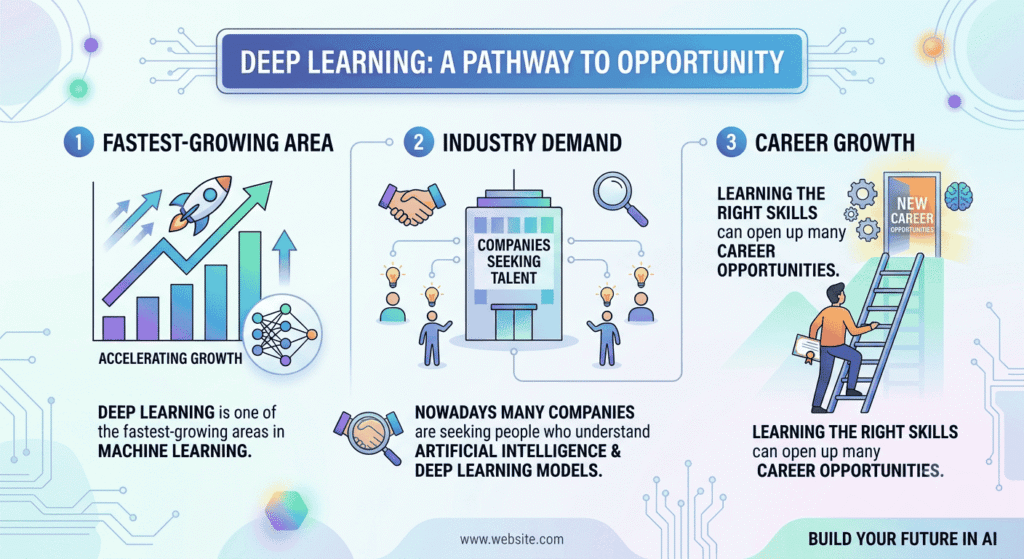
The good news is, anyone can begin to learn. You only need to be curious and practice regularly
Why Learn Deep Learning?
Deep learning is transforming a lot of industries. Companies need smarter AI systems. Hospitals need new diagnostic equipment. Schools need to improve learning platforms.
Scientists want to do research faster. So the demand for machine learning professionals is still growing. Learning deep learning today can prepare you for future jobs.
Skills You Need Before Learning Deep Learning
Deep learning may seem difficult at first. However, you can learn it step by step. Start with the basic skills first. Then move toward advanced
topics.
- Learn Basic Mathematics
- Learn Python Programming
- Learn Data Science
- Understand Machine Learning
- Learn Artificial Neural Networks
- Learn Computer Vision
- Learn Natural Language Processing
- Learn Big Data
- Learn Cloud Computing
- Build Real Projects
Popular DL Frameworks
Frameworks make it easier to build AI models. The most popular frameworks include:
- TensorFlow
- PyTorch
- Keras
- JAX
These frameworks are used by researchers and companies around the world.
Machine Learning Career Opportunities
The demand for machine learning experts continues to increase. Many industries now hire AI professionals.
Popular careers include:
- Machine Learning Engineer
- Deep Learning Engineer
- AI Engineer
- Data Scientist
- Data Analyst
- Computer Vision Engineer
- NLP Engineer
- Robotics Engineer
- AI Research Scientist
- MLOps Engineer
These careers often offer strong salaries and long-term growth.
Industries That Hire Deep Learning Professionals
Many industries use machine learning and deep learning every day.
These industries include:
- Healthcare
- Banking
- Finance
- Manufacturing
- Retail
- Agriculture
- Transportation
- Cybersecurity
- Education
- Entertainment
- Government
- Space research
Therefore, career opportunities continue expanding.
Tips to Learn Deep Learning Faster
You can improve your learning with good habits.
Helpful tips include:
- Practice every week.
- Read trusted books.
- Watch educational videos.
- Build personal projects.
- Join AI communities.
- Solve real problems.
- Keep learning new ideas.
The Future of Deep Learning Careers
The future of deep learning looks very bright. More businesses now invest in artificial intelligence. Researchers continue creating better deep learning models. Generative AI continues growing rapidly.
Healthcare is still on the path to AI adoption. Robotics continues becoming smarter. Self-driving technology continues improving. As a result, skilled professionals will remain in high demand. People who learn machine learning and deep learning today will be better prepared for tomorrow’s technology.
Why the Future of Deep Learning Looks Bright
Deep learning has already changed many industries. However, this is only the beginning. Computers are becoming more powerful. Cloud computing just continues to get better and better.
Datasets just keep getting larger. The deep neural networks are in development. As a result, deep learning models continue becoming more accurate. Companies also spend billions each year on AI research. New discoveries are coming in much faster than before.
Future Trends in Machine Learning and Deep Learning
Many exciting trends will shape the future. You should need to if you are looking for a career in artificial intelligence.
1: Smarter Generative AI
Generative AI will continue creating better content; there is much more potential in generative AI.
Future AI systems will generate:
- Articles
- Images
- Videos
- Music
- Computer code
- Educational lessons
These systems will understand human requests more effectively. Therefore, content creation will become faster. Here are the best 5 generative AI tools. 1) ChatGPT 2) Google Gemini 3) Claude AI 4) Midjourney 5) GitHub Copilot These platforms are reported to show better performance in text generation, multi-modal reasoning, artistic imagery, and software development.
2: Better Healthcare
Deep learning will improve healthcare globally. Doctors will have better decision support. Enhance medical image analysis. AI systems will help to discover new drugs. Hospitals will improve patient care. However, doctors will continue making the final medical decisions.
3: More Intelligent Robots
More intelligent robots will emerge in the future. Robots will learn their environment better. They will acquire new skills more quickly. They will also work safely with people.
Robots will help with:
- Hospitals
- Factories
- Farms
- Warehouses
- Space missions
Deep learning will allow robots to make better decisions.
4: Smarter Self-Driving Vehicles
Self-driving technology will keep getting better. Cars will get a better understanding of roads. They will recognize road signs faster. They will be better able to escape danger. Deep learning and computer vision will improve road safety.
5: Better Education
Students will receive personalized lessons. AI teachers will answer your questions. Learning systems will be customized for each student. Hence, education will become more flexible. Deep learning will also save teachers time.
6: Stronger Cybersecurity
Cyber attacks are on the rise. Deep learning will help improve digital protection. AI systems will identify threats faster. Artificial intelligence will stop attacks faster. This will help businesses and protect important information.
7: Faster Scientific Research
Scientists study huge amounts of information. Deep learning can help to analyze this data at speed. It is possible for humans overlook certain patterns that researchers uncover.
This technology facilitates research in:
- Medicine
- Climatology
- Physics
- Biology
- Astronomy
So discoveries happen faster.
Challenges That Deep Learning Must Solve
Deep learning has changed the game for machine learning and artificial intelligence. It’s dealing with a lot of difficult problems. But every technology comes with its challenges. Deep learning has some disadvantages too. Understanding these challenges allows researchers to build better AI systems. It also helps companies to apply deep learning more responsibly.
- Large Data Requirements
- High Computing Power
- High Energy Consumption
- AI Bias and Fairness
- Privacy and Data Security
- Explainability and Transparency
- High Development Costs
- Long Training Time
- Need for Skilled Professionals
- Continuous Model Maintenance
Deep Learning vs Artificial Intelligence
Many people consider deep learning the same as artificial intelligence. But it’s wrong. Deep learning is only one part of AI.
Artificial intelligence is the umbrella term that allows machines to do things that normally require human intelligence. These include learning, reasoning, planning, and decision-making. Machine learning is a subfield of AI. It lets computers learn from data, rather than just following rigid rules.
Deep learning is a subset of machine learning. It deals with solving complex problems using deep neural networks. Such networks are trained on large datasets and improve with training.
All deep learning systems are belogs to machine learning systems. Machine learning systems fall under artificial intelligence. But not all artificial intelligence systems use machine learning or deep learning.
Relationship Between Artificial Intelligence Machine Learning and Deep Learning
The relationship is simple.
Artificial Intelligence → Machine Learning → Deep Learning
- Artificial intelligence is the largest field.
- Machine learning is an important subset of artificial intelligence.
- Machine learning is a big field. Deep learning is one advanced technology.
- “Just look at it this way.
- Artificial intelligence is a large tree.
- Machine learning is a powerful branch.
- Deep learning is a subfield of machine learning.
This example makes the relationship easier to understand.
Artificial Intelligence Applications
Artificial intelligence supports many technologies.
Common AI applications include:
- Smart assistants
- Expert systems
- Robotics
- Game playing
- Smart factories
- Recommendation systems
- Fraud detection
- Medical diagnosis
Some of these systems use machine learning. Others use rule-based programming.
Deep Learning Applications
Deep learning focuses on learning from large datasets. It powers many modern AI systems.
Common deep learning applications include:
- Face recognition
- Computer vision
- Natural language processing
- Speech recognition
- Language translation
- Generative AI
- Medical image analysis
- Self-driving cars
These applications use deep learning models because they require advanced pattern recognition.
Which Technology Is Better?
Neither technology is better in every situation. Artificial intelligence is the complete field. Deep learning is a powerful tool in that area. If the problem is simple, then a rule-based AI system may be sufficient.
For images, speech, videos, or human language, deep learning tends to give better results. And so the developers select the appropriate technology for the problem they want to solve.
Conclusion
Deep learning is one of the building blocks of artificial intelligence and machine learning. It helps computers to learn from data and to solve hard problems. Deep learning is now applied in many aspects of daily life. It helps computers to understand images. It understands speech. It can read human language and understand it. It uses generative AI to predict future results and create new content.
Today deep learning is improving healthcare and education. It helps businesses make better decisions. It supports scientific research and powers many smart devices. As technology continues to grow, deep learning will become even more useful in the future. Learning deep learning today can help you prepare for tomorrow. Whether you are a student or a developer, this knowledge will help you understand the future of machine learning and artificial intelligence.
Must Read:
- How to become an AI specialist a complete word-by-word guide for beginners
- What is machine learning a complete beginner’s guide
Research References
- Association for Computing Machinery research on artificial intelligence and machine learning.
- Institute of Electrical and Electronics Engineers research papers on deep learning and neural networks.
- Google Research publications on Transformer models and generative AI.
- OpenAI technical reports on large language models.
- DeepMind research on reinforcement learning and advanced AI systems.
- MIT Computer Science and Artificial Intelligence Laboratory research on robotics and machine learning.
- Stanford Human-Centered Artificial Intelligence reports on responsible AI and future trends.
Expert References
The article reflects concepts and research associated with leading experts, including:
These researchers have made major contributions to modern machine learning, deep learning, computer vision, natural language processing, and artificial intelligence.
Frequently Asked Questions
Deep learning is a type of machine learning that uses deep neural networks to learn from large amounts of data.
Yes. Deep learning is an advanced branch of machine learning.
Machine learning often needs human feature selection. Deep learning learns many features automatically.
An artificial neural network is a computer system inspired by the human brain.
Deep learning is used in healthcare, education, banking, transportation, cybersecurity, and entertainment.
Yes. Python is the most popular programming language for deep learning.
Yes. Basic mathematics helps you understand machine learning models.
Yes. Beginners can learn step by step with regular practice.
TensorFlow and PyTorch are two of the most popular frameworks.
Yes. Deep learning careers continue growing because businesses need skilled AI professionals.
The time depends on your experience and practice. Many beginners build a solid foundation within several months of consistent study.
No. Deep learning helps people perform tasks more efficiently. Human creativity, judgment, and responsibility remain essential.