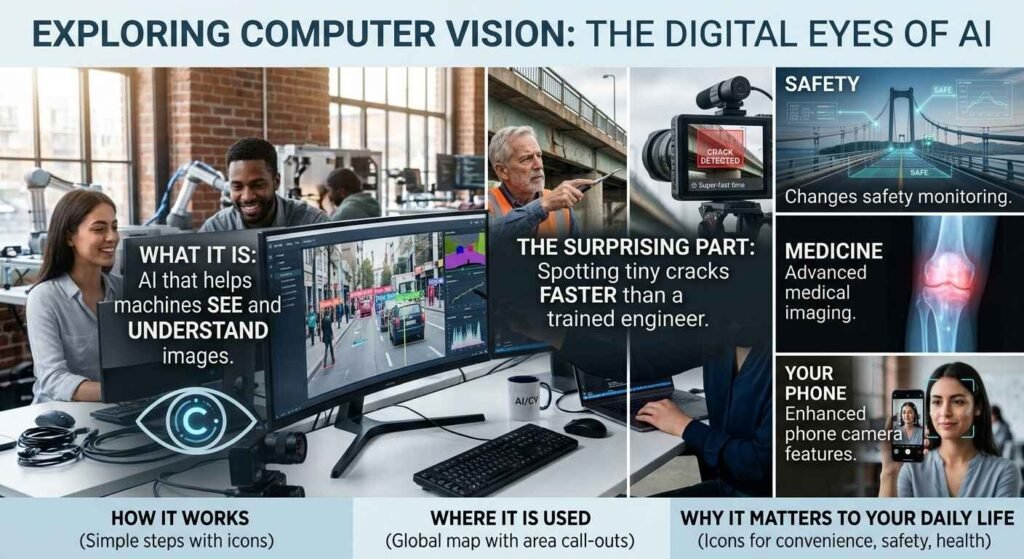
There are 8 main types of computer vision models. We need to discuss and better understand each model. You’ve unlocked your phone with your face. You’ve scanned yourself. You have watched a self-driving car merge into traffic. Every time, you’ve fallen back on a computer vision model.
These systems allow machines to understand images and videos in the way a human would. But they don’t all operate the same. There are a few different kinds of computer vision models. Each is for a different type of visual task. This guide explains the major types of computer vision models.
You’ll discover what they do, how they work, and where to find them. Whether you’re a student, an AI specialist, or a business owner, you’ll get a clear map to the landscape. If you are a beginner and want to become an AI expert, you need to also read what machine learning ? And what deep learning?
What Are Computer Vision Models?
A computer vision model is a kind of artificial intelligence system. It is trained to figure out the meaning of images or videos. It recognizes objects, boundaries, actions or context immediately recognizable for a human viewer. Computer vision is a subfield of AI itself. It allows machines to see, analyze, and understand images. This is strongly dependent on machine learning.
Computer vision breaks down into three interacting processes. Recognition means identifying objects, people, or text in an image. Reconstruction is about figuring out the three-dimensional shape of what is in the scene.
Reorganization is about learning the relationships among the recognized entities. Different computer vision models perform different combinations of these processes.
Different computer vision models are looking for different things. One model could just respond with, “What is the main subject of this photo?” Another might draw a box around each car in a traffic feed.
A third might need to trace the precise contour of a tumor in an MRI scan, pixel by pixel. These tasks are all different. Each task has given rise to its own family of model architectures.
How Do Computer Vision Models Work
From pixels to predictions
At the very simplest level, a digital image is just a grid of numbers. These pixel values represent color and brightness. The job of a computer vision model is to take that grid and make sense of it. That might be a label, a coordinate set, or a map of regions.
Almost all modern computer vision models built on neural networks. These are computational systems loosely modeled on the way neurons in the brain pass signals to each other.
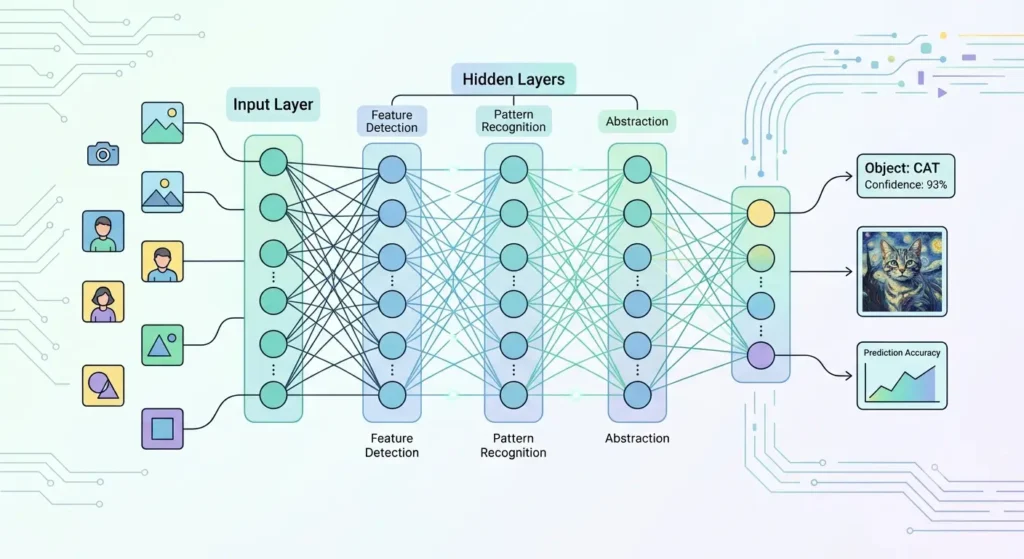
A neural network is composed of layers of interconnected nodes. The early layers usually learn simple visual features like edges or color gradients. Deeper layers combine those patterns into more abstract concepts and eventually recognize shapes, textures and whole objects.
Training vs. inference
First, before a model can do anything useful, it should be trained. It sees a lot of pictures with labels, like a photo labelled “cat.” It tunes its internal parameters so that it can predict the labels.
Once trained, the model can be used for inference, making predictions on new images it has never seen. What shape those predictions take depends on what kind of computer vision model you select.
That could be a single label. A list of bounding boxes, a full pixel map, or a natural language description.
Traditional Computer Vision vs. Deep Learning Models
Not all computer vision models are deep neural networks! Before the start of deep learning, computer vision relied on handcrafted feature-extraction methods.
Techniques such as the Scale-Invariant Feature Transform (SIFT) and the Histogram of Oriented Gradients (HOG) identify edges and corners.
They do it by means of gradient patterns. They use fixed math rules, not learned weights. These features were then used to train classical machine learning classifiers, such as support vector machines.
Traditional methods still appear in production systems today. They are especially useful where labelled training data is scarce or computing power is limited. Aalso excel at narrow, well-defined tasks, such as reading a barcode or aligning two photos for a panorama. They are usually lightweight, predictable and easy to debug.
Deep learning computer vision models work differently. Instead of using hand-designed rules. They learn their own features directly from raw pixels. The change is driven by convolutional neural networks that are trained on big collections of labelled data. That’s what moved computer vision from a research niche into an everyday consumer technology.
Most researchers place the turning point in 2012. The large-scale ImageNet dataset was used to train a convolutional neural network, called AlexNet that year. It cut the error rate on image identification benchmarks drastically. It kicked off the modern wave of computer vision research.
The Main Types of Computer Vision Models
1: Image Classification Models (CNNs)
Image classification models answer one question. What is this picture mostly about? They assign one label or a ranked list of labels to the whole image. The convolutional neural network or CNN, is the most powerful architecture for this task. A CNN applies small, learnable filters to an image.
They automatically choose visual patterns such as edges, textures and shapes. Simple patterns are detected by early layers. Later layers combine them into higher-level concepts that the network can use to classify the whole image.
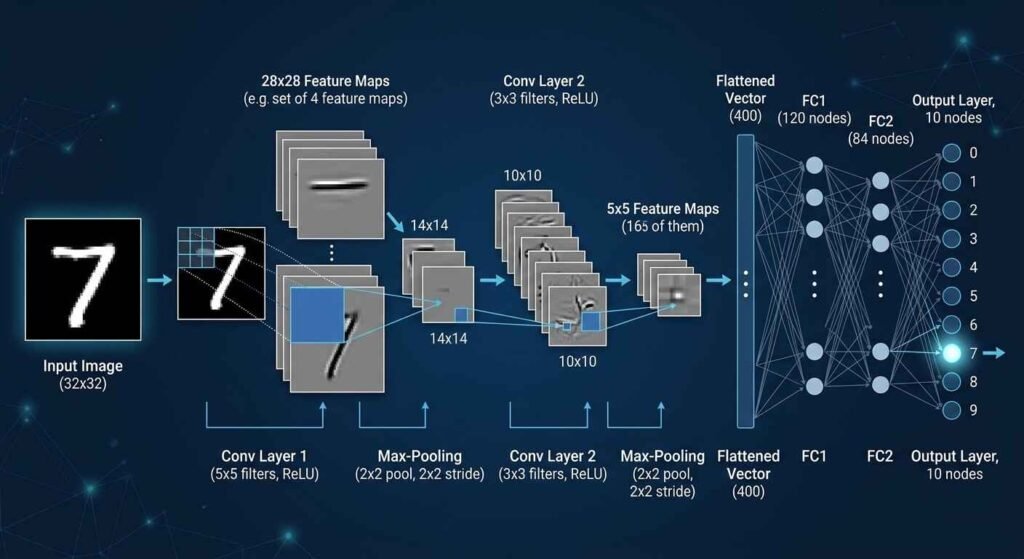
Well-known CNN architectures include:
⦁ AlexNet: the 2012 model that popularized deep CNNs for image recognition.
⦁ VGGNet: known for a simple, uniform design built from stacked 3×3 convolution filters.
⦁ ResNet: introduced “residual connections” that let networks grow much deeper without degrading in accuracy.
⦁ EfficientNet: designed to scale depth, width, and resolution together for better accuracy per unit of computing power.
The most fundamental task in computer vision is image classification. This is usually the first thing a beginner builds. It also forms the basis of more complex tasks such as object detection and segmentation.
2: Object Detection Models (R-CNN family, YOLO, SSD)
Classification is a step lower than object detection. It doesn’t produce one label for the whole image, it finds all the objects of interest. It draws a bounding box and a class label for each one. There are generally two design philosophies for object detection models. Two-stage detectors first propose candidate regions that might contain an object. Then they classify each of the areas and refine it.
The R-CNN family follows this strategy:
⦁ R-CNN used an external algorithm to propose regions and then ran a separate CNN on each one. It was slow but accurate.
⦁ Ross Girshick’s Fast R-CNN processes the whole image through the CNN only once. The resulting features were shared for all region proposals, which reduced the training and testing time dramatically.
⦁ Faster R-CNN replaced the external region proposal step with a learned Region Proposal Network. This enabled the whole pipeline to be trained end-to-end and brought the system closer to real time.
One-stage (single-shot) detectors perform the prediction of bounding boxes and class labels directly in a single pass over the image. They trade some accuracy for a lot of speed.
- YOLO (You Only Look Once) was introduced by Joseph Redmon and his friends. It reframed object detection as a single regression problem, such as dividing the image into a grid. It predicts boxes and class probabilities for each cell in one forward pass. The original YOLO ran in real time. The architecture has continued evolving through many later versions maintained by different research teams.
- SSD (Single Shot MultiBox Detector) takes a similar single-pass approach. It predicts boxes at multiple feature-map scales to catch objects of different sizes.
Everything from security cameras to retail shelf scanning is powered by object detection. Additionally, it powers the advanced driver-assistance systems’ pedestrian and vehicle detection systems.
3: Image Segmentation Models (Semantic, Instance, Panoptic)
Segmentation models do not only draw a box around an object. They classify each pixel in the image. This is the most fine-grained of the mainstream computer vision tasks and it has three flavors.
- Semantic segmentation tags every pixel with a class, such as road, sky, car, or person. It is not able to distinguish between different occurrences of the same class. Two cars that overlap merged into one region of a car. Typical architectures are Fully Convolutional Networks (FCN), U-Net, and DeepLab.
- Instance segmentation is more advanced. It detects each object separately and assigns it a separate pixel-level mask. The two adjacent cars are properly separated into “car 1” and “car 2.” The best-known model for this task is the Mask R-CNN detector, which extends the Faster R-CNN detector.
- Panoptic segmentation combines both. It assigns a semantic label to each pixel and a unique instance ID to each object that can be counted. This is the most complete description of the scene of the three of them.
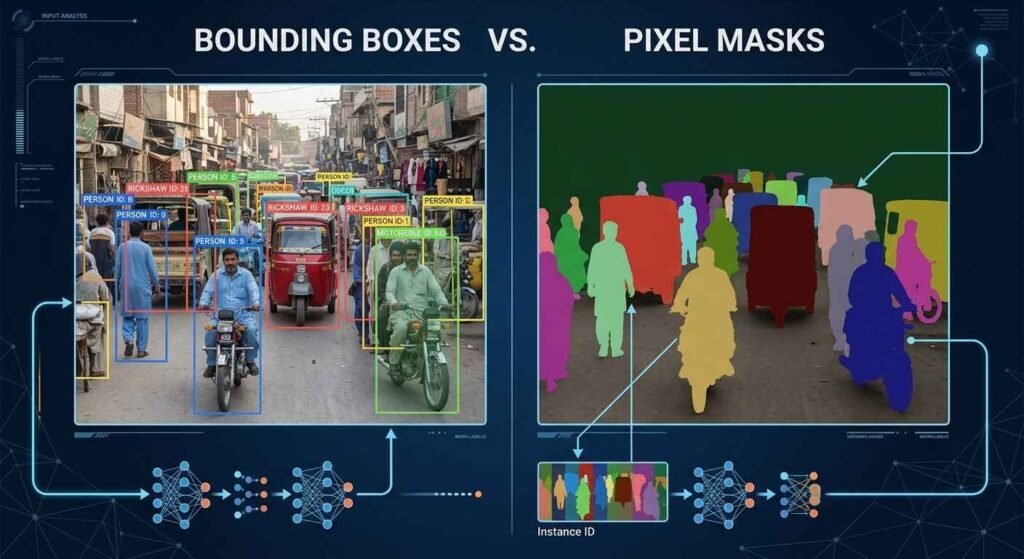
Segmentation is important where there is a need for an exact boundary. Such examples are medical imaging, for outlining a tumor, and autonomous driving, to define the drivable road surface. It is used in satellite imagery to map land use.
4: Vision Transformer (ViT) Models
For most of the 2010 CNNs were thought to be the only viable architecture for vision. Then came the Vision Transformer and changed that. It was first proposed by Google researchers in a 2020 paper called “An Image Is Worth 16×16 Words.”
Instead of sliding filters over an image, ViT divides it into fixed-size patches. It treats each patch as a “word” in a sentence. It applies the self-attention mechanism developed for language models to the entire sequence. Using self-attention the model can look at the relationship between any two patches in the image, not just pixels nearby. This allows ViTs to have an advantage in capturing long-range context.
The original work on ViT showed that it can achieve comparable or better results than state-of-the-art CNNs. When pre-trained on large datasets. It did it with less training compute. However, the assumptions of CNNs about locality still appear to give them an edge in smaller datasets.
Notable variants extend the idea for practical use:
- Swin Transformer processes patches in local “windows” and shifts the windows between layers. It combines the flexibility of the transformer with the efficiency of CNNs for detection, segmentation and classification.
- DeiT (Data-efficient Image Transformer) obtains strong accuracy with knowledge distillation. It requires far less training data than the original ViT.
5: Generative Vision Models (GANs and Diffusion Models)
Not every computer vision model is built to recognize images. Some are built to create them. Generative vision models learn the underlying patterns in a dataset of images. They learn well enough to produce entirely new, realistic images.
- Generative Adversarial Networks (GANs) were introduced by Ian Goodfellow and colleagues in 2014. They pit two neural networks against each other. A generator creates fake images, and a discriminator tries to tell real images from generated ones. The two networks train together. The generator gradually gets better at producing images the discriminator can’t distinguish from real ones. Well-known GAN variants include StyleGAN, for high-resolution photorealistic faces, and CycleGAN, for translating images between styles or domains.
- Diffusion models work differently they learn to reverse a process of gradually adding random noise to an image. This effectively teaches them to “denoise” pure static back into a coherent picture, step by step. Diffusion models have become the dominant approach for high-fidelity, text-to-image generation. They tend to produce more diverse outputs and train more stably than GANs. They generally need more computation per image, though.
Generative models show up in synthetic data generation for training other models. They’re also used in creative and design tools, image restoration, and content-editing applications.
6: Multimodal / Vision-Language Models (CLIP and similar)
A newer category of computer vision model doesn’t just look at images. It connects images to natural language. CLIP (Contrastive Language-Image Pre-training), developed by OpenAI, is the best-known example.
CLIP is trained on large numbers of image-text pairs. It learns to place matching images and captions close together in a shared representation space.
This joint training lets CLIP and similar models perform “zero-shot” classification. They can sort images into categories they’ve never seen. It just compares the image to a text description of each category.
This makes multimodal models unusually flexible foundation models. They’re useful for image search, content moderation, captioning, and as the visual “eyes” inside larger multimodal AI systems.
7: Pose Estimation and Action Recognition Models
Some of the computer vision tasks are dedicated to the human body. Pose estimation models detect key body joints such as shoulders, elbows and knees. They link them into a skeleton. Which is helpful for fitness apps, sports analytics, motion capture, and human computer interaction.
Action recognition models are even more. They will look at a pose over several frames of video. This allows them to classify activities such as walking, falling or waving.
8: Video and Sequential Vision Models
Static-image models process one frame at a time. But many real-world problems require understanding motion and sequence, like tracking a car across frames or recognizing a gesture. Video-focused computer vision models add a temporal dimension on top of spatial understanding.
They often combine CNN-based or transformer-based frame encoders with sequence models. Historically these were recurrent neural networks; increasingly they’re temporal transformer variants. Together they reason about how a scene changes over time.
CNN vs. Vision Transformer: What’s the Difference?
| CNN | Vision Transformer (ViT) | |
|---|---|---|
| Core mechanism | Convolutional filters that slide across local regions | Self-attention across all image patches |
| Data efficiency | Performs well on smaller datasets | Needs large-scale pretraining data to shine |
| Inductive bias | Built-in assumptions about locality and spatial hierarchy | Few built-in assumptions; learns relationships from data |
| Typical strength | Efficient, mature, and works well at a moderate scale | Captures long-range, global context in an image |
| Common use | Classification, detection backbones, edge devices | Large-scale classification, detection/segmentation backbones, foundation models |
Neither architecture has fully replaced the other. In practice, many current systems are hybrids. They use convolutional layers early on for efficient feature extraction. Transformer blocks then capture global relationships later in the network.
Why Computer Vision Models Matter
Manually reviewing images and video at scale isn’t practical. A single retail chain, hospital network, or city’s traffic-camera system generates enormous volumes of visual data. No team of people could review it all.
Computer vision models let organizations extract structured information from that flood of data automatically and consistently. That’s why the technology has moved from research labs into everyday products so quickly.
Real-World Applications of Computer Vision Models
- ⦁ Healthcare assisting radiologists by selecting suspicious sites in X-ray, CT and MRI for more detailed review.
- ⦁ Autonomous vehicles detection, segmentation and tracking of lanes, pedestrians, vehicles and road signs.
- ⦁ Retail automating checkouts, monitoring shelf stock and analyzing foot traffic in stores.
- ⦁ Manufacturing faster and more consistently than manual visual inspection, for defect detection on production lines.
- ⦁ Agriculture identifying pests and assessing crop health from drone and satellite photos.
- ⦁ Security and access control face verification, license-plate recognition, and anomaly detection in video feeds.
- ⦁ Augmented reality follows real-world surfaces and objects so virtual content can be convincingly overlaid.
Benefits of Modern Computer Vision Models
Modern computer vision models can process visual information quickly. They often provide more consistent performance on well-defined benchmark tasks than manual review. They also scale nicely. Once trained, a model can be deployed over thousands of cameras or images with no human effort per image.
They also get better with more training data and improved architectures over time. They are getting more and more general across tasks, rather than requiring a fully custom-built system for each new use case.
Limitations and Challenges
Computer vision models are not perfect. They often provide more consistent performance on well-defined benchmark tasks than manual review.
They also scale nicely. Once trained, a model can be deployed over thousands of cameras or images with no human effort per image. Their reliability should not be overstated.
- Data dependence. Deep learning models require a large volume of labelled data for training. Their performance is only as good as the quality and diversity of that data.
- Impartiality and bias. If some groups or conditions are under represented in the training data, the accuracy can degrade unevenly across them. This is a well-known issue in facial recognition and identity applications.
- Shift in Domain. A model trained on daytime traffic in one city might not transfer to nighttime traffic in another. has to be retrained or fine-tuned to adapt.
- No actual understanding. Statistical regularities can be picked out even by accurate models, but they don’t really understand a scene. This can lead to confidently wrong predictions on strange or adversarial inputs.
- Computational cost. Running and training large models, especially transformers and generative models, can be very resource intensive.
How to Choose the Right Computer Vision Model
There is no “best” model for computer vision. The correct choice depends on the task.
- Define the output you require: One label per image suggests classification. Detection with multiple objects with locations pointing. Segmentation implies precise boundaries.
- Check your data volume: CNNs tend to be more data-efficient at small scales. For vision transformers, larger datasets or strong pre-trained checkpoints are usually required to unlock their full potential.
- accuracy vs speed: One-stage detectors like YOLO achieve real time speed at the cost of some accuracy. Two-stage detectors, such as Faster R-CNN, are typically more accurate but slower to run than one-stage models.
- Consider your environment of deployment: Edge devices and mobile apps prefer lightweight architectures. Cloud systems can support bigger models.
- First, look for pretrained foundation models: Usually, training from scratch is less practical than fine-tuning an existing model (CNN,a ViT or CLIP-style).
Common Mistakes When Working With Computer Vision Models
- Using a model type that does not fit the task: Such as a classifier when detection is required.
- Underestimating the labelling effort: Segmentation and detection datasets are so much more time-consuming to label than simple classification datasets.
- Ignoring class imbalance: Unless the training explicitly accounts for it, rare object classes are overwhelmed by common ones.
- Skipping validation on real world conditions: Only testing on clean data. Not messy lighting, angles, and occlusion.
- Accuracy is the only metric: In production speed, memory footprint and fairness often matter just as much.
The Future of Computer Vision Models
Several current directions look set to continue shaping the field. Vision transformers and hybrid CNN-transformer architectures keep closing the gap with pure CNNs. In some benchmarks, they now exceed them, particularly as pretraining datasets grow.
Multimodal, vision-language foundation models are expanding beyond classification into open-ended reasoning about images. And more attention is going toward making models efficient.
The goal is capable computer vision that runs directly on phones and cameras, without needing a constant cloud connection.
These are active research trends, not settled facts. The pace of change in this field is fast. Today’s state-of-the-art model family may be supplanted within a few years. That’s the same way CNNs supplanted handcrafted features, and transformers began challenging CNNs.
Conclusion
There isn’t one “computer vision model.” There’s a family of model types, each purpose-built for a different visual task. CNNs remain the reliable default for classification and as detection backbones.
The R-CNN family and YOLO cover object detection from different angles: accuracy-first versus speed-first. Segmentation models add pixel-level precision. Vision transformers bring long-range context and now rival CNNs at scale.
GANs and diffusion models generate new images rather than analyzing existing ones. And multimodal models like CLIP connect vision to language, enabling far more flexible, zero-shot use cases.
Understanding these categories isn’t just academic. It’s the fastest way to figure out which model actually fits your problem. That beats defaulting to whichever architecture is currently trending.
FAQ
What are the main types of computer vision models?
How many types computer vision models are there?
What is CNN in Computer Vision?
What is a vision transformer in computer vision?
Difference between image segmentation and object detection?
Waht is the difference between semantic and instance segmentation?
What is YOLO in computer vision?
CNN or vision transformer which is better?
Research Sources and References
- IBM. “What Is Computer Vision?” IBM Think. https://www.ibm.com/think/topics/computer-vision
- IBM. “What Are Convolutional Neural Networks?” IBM Think. https://www.ibm.com/think/topics/convolutional-neural-networks
- IBM. “What Is Image Segmentation?” IBM Think. https://www.ibm.com/think/topics/image-segmentation
- IBM. “What Is Semantic Segmentation?” IBM Think. https://www.ibm.com/think/topics/semantic-segmentation
- Dosovitskiy, A., et al. “An Image Is Worth 16×16 Words: Transformers for Image Recognition at Scale.” arXiv, 2020. https://arxiv.org/abs/2010.11929
- Redmon, J., Divvala, S., Girshick, R., Farhadi, A. “You Only Look Once: Unified, Real-Time Object Detection.” arXiv / CVPR, 2016. https://arxiv.org/abs/1506.02640
- Girshick, R. “Fast R-CNN.” arXiv, 2015. https://arxiv.org/pdf/1504.08083
- Ren, S., He, K., Girshick, R., Sun, J. “Faster R-CNN: Towards Real-Time Object Detection with Region Proposal Networks.” arXiv / NeurIPS, 2015. https://arxiv.org/abs/1506.01497
- Roboflow. “What Is YOLO? The Guide to YOLO Models.” https://blog.roboflow.com/guide-to-yolo-models/
- Radford, A., et al. (OpenAI). “CLIP: Connecting Text and Images.” Referenced via Roboflow explainer: https://blog.roboflow.com/openai-clip/
- GeeksforGeeks. “Difference between Traditional Computer Vision Techniques and Deep Learning-based Approaches.” https://www.geeksforgeeks.org/computer-vision/difference-between-traditional-computer-vision-techniques-and-deep-learning-based-approaches/
- GeeksforGeeks. “Semantic Segmentation vs Instance Segmentation.” https://www.geeksforgeeks.org/computer-vision/semantic-segmentation-vs-instance-segmentation/